Back
Skin Longevity: A Five-Pathway Framework for Clinicians

Dr. Neil Panchal
Co-founder and Chief Medical Officer
Share:

A 46-year-old executive brings her skin longevity routine to a consult. Tretinoin from her dermatologist. An exosome serum and quarterly microneedling from a med spa. A saliva kit that put her “skin age” five years above her real age. A topical NAD+ precursor and oral collagen from a functional medicine clinician. Three months of poor sleep and low HRV on her Oura ring. Sunscreen, most mornings.
She wants to know which of these is doing anything. Nobody has given her an answer, because nobody has seen the whole list.
That patient is a composite, and most longevity physicians will recognize her. This article lays out a framework for sorting her routine: five biological pathways, the evidence tier behind each, and where the skin fits in preventive medicine.
What skin longevity means in clinical terms
Skin longevity is the skin’s capacity to keep its function and resilience over time. Appearance follows function. Barrier integrity, repair capacity and inflammatory tone are things we can measure and change.
The term has been stretched by marketing. It still describes something real when three conditions hold:
- The intervention targets a defined biological mechanism.
- Human outcome data support it, measured with validated endpoints.
- The skin is read as part of systemic aging biology.
The five pathways of skin aging
The framework below is a reasoning scaffold. It gives you a way to ask what a product or therapy is supposed to do, and whether anyone measured it doing that in people.
| Pathway | What it covers | Strongest human evidence | Where claims outrun data |
|---|---|---|---|
| Repair efficiency | Collagen turnover, DNA repair, wound healing | Topical tretinoin (randomized trials since 1988) | Exosomes, most growth factor serums |
| Damage resistance | UV and oxidative stress | Daily broad-spectrum sunscreen (Nambour RCT) | Most antioxidant claims beyond photoprotection |
| Inflammatory control | Inflammaging, senescence-related inflammation | Niacinamide, azelaic acid | Plant polyphenols (mostly preclinical) |
| Barrier resilience | Stratum corneum lipids, water loss | Physiologic lipid replacement (ceramides, cholesterol, fatty acids) | “Barrier” claims with no water-loss data |
| Cellular energy | NAD+, mitochondrial function | Niacinamide (mechanism plus some clinical data) | Topical NMN and NR, topical senolytics |
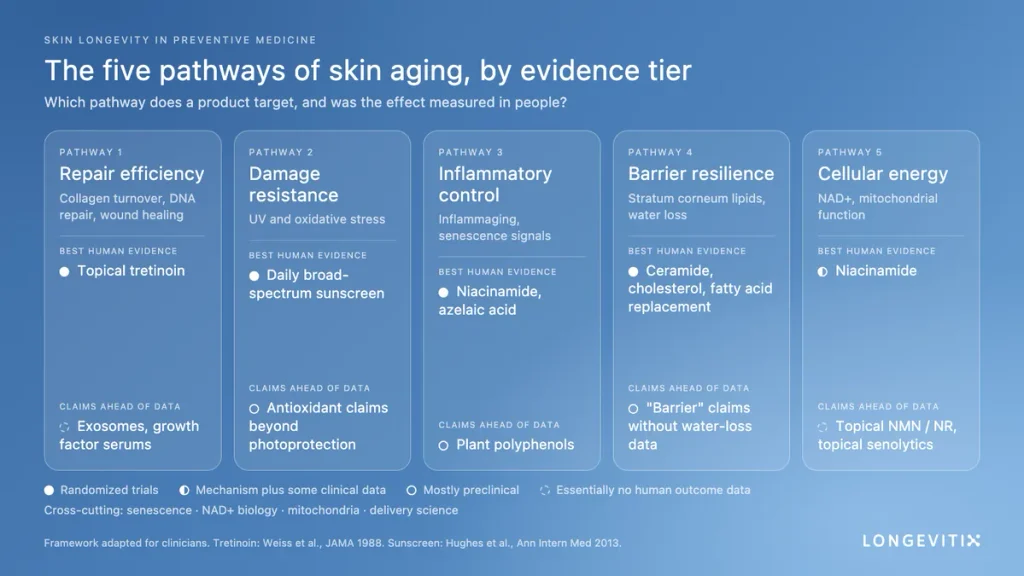
Four themes cut across all five pathways: cellular senescence, NAD+ biology, mitochondrial function and delivery science. Delivery matters more than most labels admit. Molecules above roughly 500 daltons penetrate intact skin poorly (Bos and Meinardi, 2000). Epidermal growth factor weighs about 6,000.
Each pathway gets its own treatment later in this series. Daily sunscreen and skin aging covers damage resistance. Skin barrier repair covers barrier resilience. The evidence on exosomes, NAD+ and senolytics covers the pathways where marketing has run furthest ahead.
The skin as a biomarker of systemic aging
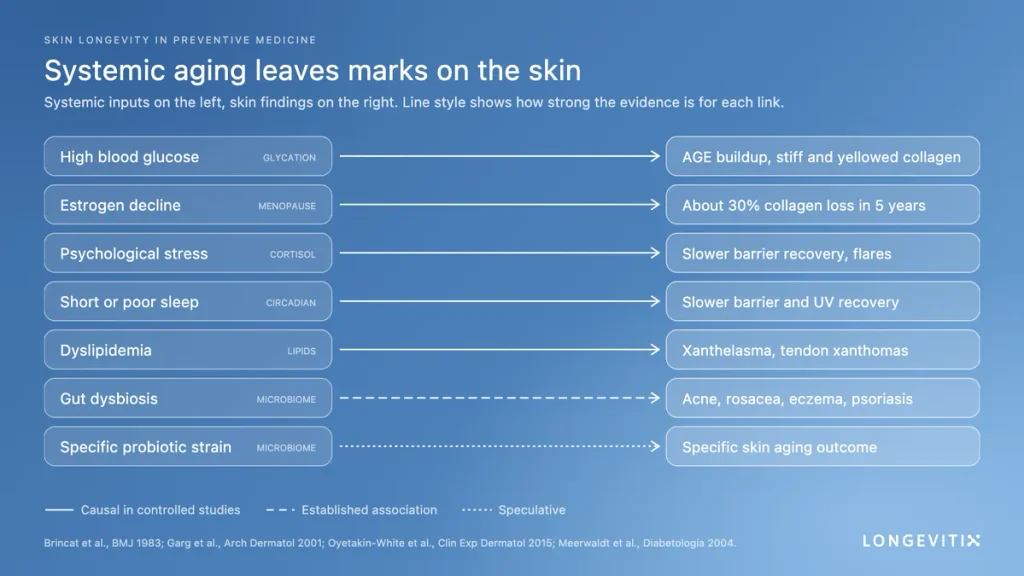
Glycation, hormonal transition, inflammaging, vascular function, circadian rhythm and stress load all leave marks on the skin. That makes skin findings part of a preventive workup.
The strength of those links varies, and it should be labeled:
- Causally linked in controlled studies. Skin collagen falls by about 30% in the first five years after menopause (Brincat et al., 1983, and later work by the same group). Psychological stress slows barrier recovery (Garg et al., 2001). Poor sleep does too (Oyetakin-White et al., 2015).
- Established associations. Psoriasis is an independent cardiovascular risk factor. Skin autofluorescence, a measure of glycation, predicts cardiac mortality in type 2 diabetes and all-cause mortality in dialysis patients.
- Mechanism supported, outcome data emerging. Gut microbiome shifts and skin aging in healthy adults.
- Speculative. A specific probiotic strain producing a specific skin aging outcome.
We covered the findings-to-systems side of this in reading the skin as systemic data. The glycation thread continues in skin autofluorescence and cardiometabolic risk.
Why integration is the bottleneck in skin aging prevention
The science on skin aging prevention is further along than the care built around it. Five gaps keep the patient in the opening example stuck:
- Provider silos. A dermatologist, an aesthetic practice, a longevity clinician and a med spa may all touch the same face. Each sees part of the regimen.
- Topical and systemic care sit in separate charts. Estrogen decline drives collagen loss, yet the skin routine and the hormonal picture rarely live in one record. Skin changes on GLP-1 therapy are often missing from dermatologic histories (more on that here).
- Evidence tiers go unlabeled. Patients experience RCT-grade sunscreen and a mechanism-only serum as one “routine.” When cost or irritation forces a cut, the cheapest and best-proven step often goes first.
- Nobody tracks skin over time. Patients who know their LDL trend don’t know their transepidermal water loss trend. Their wearables produce months of sleep and HRV data that never reach the clinician looking at their skin.
- Regulatory status is invisible. Packaging rarely tells a patient whether a product is a drug, a cosmetic or an unapproved biologic.
Where decision support fits
An integrated record can do three things for skin longevity work:
- Structure skin findings as systemic signals. Accelerated photoaging, post-menopausal collagen loss and raised skin autofluorescence each point to a system beyond the skin. The platform surfaces those links for the physician to assess.
- Put topical, systemic and lifestyle levers on one evidence layer. A retinoid, a ceramide moisturizer, hormone therapy timing, GLP-1 effects and sleep all land on the same organ. Seeing their evidence tiers side by side shows which are redundant and which may interact.
- Track skin and systemic trends together. Quarterly skin measures next to continuous wearable data turn a snapshot into a trajectory.
Think of the platform as a resident who has read every chart and every trial before rounds. The attending still makes the call.
The Nambour sunscreen trial was published in 2013. Most skin longevity routines still treat its finding as optional.
FAQs
What is skin longevity?
The skin’s capacity to keep its barrier, repair and inflammatory function over time. In clinical use, it means interventions with a defined mechanism and human outcome data, read alongside systemic aging biology.
Which skin longevity interventions have the strongest evidence?
Daily broad-spectrum sunscreen, a tolerated topical retinoid, physiologic barrier lipid replacement, not smoking and adequate sleep. Together these cover most of the modifiable variance for most patients.
Is skin aging a sign of systemic aging?
Sometimes, and the strength of the link varies. Some connections are causal, such as estrogen and collagen. Others are associations, such as psoriasis and cardiovascular risk. Label which is which before acting on it.
Are “biological skin age” tests useful?
Not yet for clinical decisions. First-generation consumer methylation clocks lack standardization and reliability, and the more promising organ-specific clocks aren’t commercially available (Wyss-Coray and Topol, Nature Medicine, 2026). See why biological age clocks disagree.