Back
Women’s Health and Drug Dosing: The Male Data Problem

Dr. Neil Panchal
Co-founder and Chief Medical Officer
Share:

Most physicians dose drugs by indication, sometimes by weight, and almost never by sex. The trials behind those doses enrolled mostly men, and the research on women’s health drug dosing now shows what that has cost women.
Women absorb, distribute and clear many common drugs differently from men. Standard doses often produce higher blood levels in women, and higher blood levels track with more side effects.
This article covers where the gap came from, what the pharmacokinetic data shows, and what a prescriber can do about it this week.
How women’s health was left out of the drug evidence base
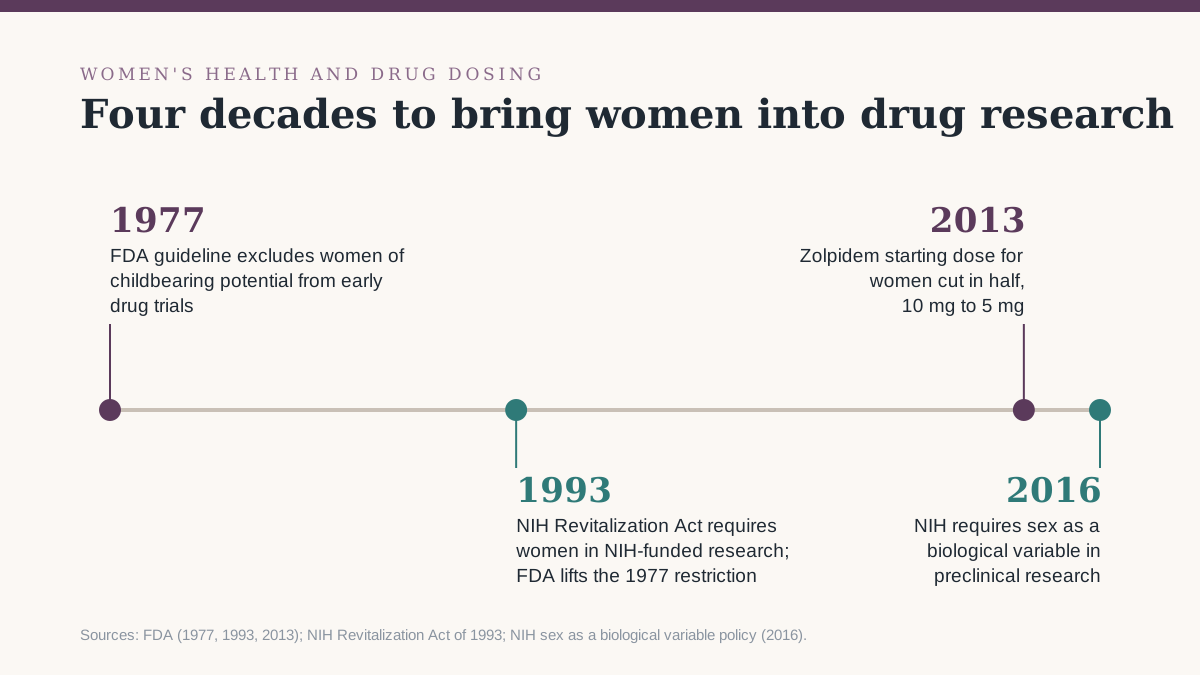
After thalidomide, a 1977 FDA guideline excluded women of childbearing potential from Phase I and early Phase II drug trials. The goal was to protect a possible pregnancy. The result was that first-in-human dosing data came almost entirely from male volunteers.
The correction took decades. In 1993, the NIH Revitalization Act required NIH-funded clinical research to include women, and the FDA lifted its 1977 restriction the same year. In 2016, the NIH began requiring researchers to treat sex as a biological variable in preclinical work, including animal and cell studies.
Many drugs we prescribe every day were dosed before those changes took hold.
What the pharmacokinetic data shows
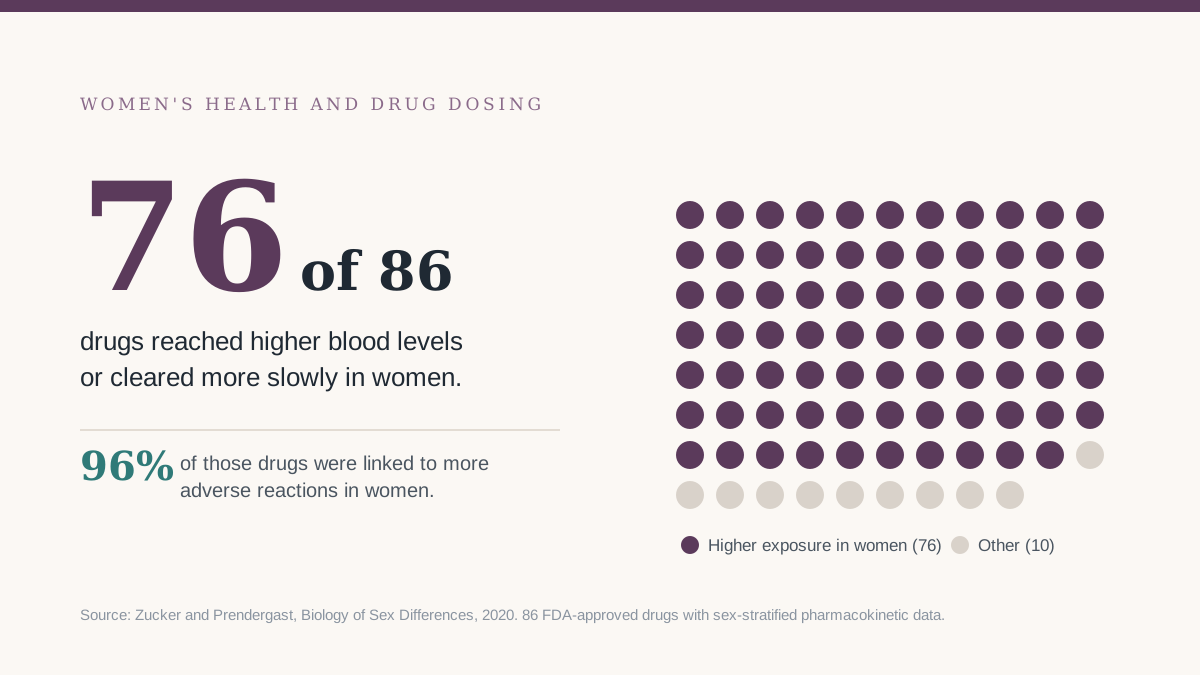
In 2020, Irving Zucker and Brian Prendergast reviewed 86 drugs with sex-stratified pharmacokinetic data (Biology of Sex Differences, 2020). Their findings:
- 76 of the 86 drugs reached higher blood concentrations or cleared more slowly in women.
- Among 59 drugs with clear adverse drug reaction data, the direction of the pharmacokinetic difference predicted the direction of the side-effect difference in 88% of cases.
- 96% of drugs with female-biased pharmacokinetics were linked to more adverse reactions in women.
The authors concluded that women are often overmedicated at standard doses. Two years later, the same group reported that sex-based pharmacokinetic analysis was still uncommon in drug research (Cold Spring Harbor Perspectives in Biology, 2022).
One caveat matters here. Accessible sex-stratified data exists for only a small share of drugs. The 86 in this study are the ones we can see.
The zolpidem example
Zolpidem shows what happens once someone looks. Women clear zolpidem more slowly than men, and post-marketing reports described next-morning impairment, including impaired driving. In 2013, the FDA cut the recommended starting dose of immediate-release zolpidem for women in half, from 10 mg to 5 mg.
Sex-specific dose changes after approval remain rare. That rarity reflects how seldom anyone reviews the data.
Women are still underrepresented in clinical trials
Inclusion laws opened trials to women. Enrollment has lagged behind.
Cardiovascular disease is the leading cause of death in women, yet women remain under-enrolled in cardiovascular trials relative to their share of the disease (Filbey et al., 2022). Stroke trials show the same pattern (Carcel and Reeves, 2021). Filbey and colleagues propose that trials report a participant-to-prevalence ratio, so readers can see the gap at a glance.
For prescribers, the practical issue is statistical power. When a trial is 25% female, its subgroup results for women are often too small to detect a sex-specific risk. We covered one example of this in statin response in women across the menopause transition.
Women’s health drug dosing: what prescribers can change now
You can account for sex differences in pharmacokinetics without waiting for new guidelines. A few habits close part of the gap.
Treat side effects as a possible dosing signal. When a woman reports side effects at a standard dose, consider higher drug exposure before attributing it to anxiety or poor tolerance. A lower dose may solve the problem.
Check hormonal context. Oral estrogen raises thyroxine-binding globulin, so women on levothyroxine often need a dose increase after starting it. Transdermal estrogen has much less effect on binding proteins. Pregnancy, hormonal contraception and the menopause transition all shift drug handling.
Take extra care with narrow therapeutic windows. Women have a longer baseline QTc and a higher risk of drug-induced torsades de pointes. Sedatives, opioids and QT-prolonging drugs deserve a second look at the dose.
Document sex-specific adverse reactions and report them. Post-marketing data is how zolpidem got corrected.
Where decision support helps
The data on women’s health drug dosing is scattered across label pharmacology sections, research papers and post-marketing reports. Few clinicians have time to pull it up during a visit.
Software can carry part of that load. At Longevitix, we built our decision support so that a patient’s sex and reproductive stage sit alongside her medication list, and relevant sex-stratified pharmacokinetic data is flagged at the point of prescribing. The platform surfaces the information. The physician reviews it and decides. That depends on having the patient’s data in one place, which we wrote about in why preventive medicine fails without data unification.
The gap took fifty years to build. The first step in closing it is putting the existing evidence in front of the prescriber.
FAQs
Why do women often need lower doses of some drugs?
On average, women have lower body weight, a higher percentage of body fat, and differences in liver enzyme activity and kidney clearance. For many drugs, that adds up to higher blood levels at the same dose.
What does “sex as a biological variable” mean?
It is an NIH policy, in place since 2016, that requires researchers to consider sex in the design, analysis and reporting of preclinical studies.
Should I lower doses for every female patient?
No. Adjust where the evidence supports it: drugs with known female-biased pharmacokinetics, drugs with a narrow therapeutic window, and patients reporting side effects at standard doses.
Where can I find sex-specific pharmacokinetic data for a drug?
Start with the “Use in Specific Populations” and clinical pharmacology sections of the label. The supplementary tables in Zucker and Prendergast (2020) list the 86 drugs they analyzed.