Back
Medication Reconciliation for Peptides in Longevity Medicine

Dr. Neil Panchal
Co-founder and Chief Medical Officer
Share:
Most physicians reconcile medications at every visit. Few apply the same care to supplements, hormones and peptides. In longevity medicine, where many patients take all three, weak medication reconciliation for peptides and supplements leaves much of the plan out of the chart.
The medication list in most electronic medical records was built for pharmaceuticals. Everything else ends up in a free-text field, a buried note, or nowhere. For a longevity patient, the free-text field often holds more active interventions than the formal list.
This article covers how big the documentation gap is, why it persists, and what a clinic can change.
How much supplement use the chart misses
The numbers are consistent across very different populations.
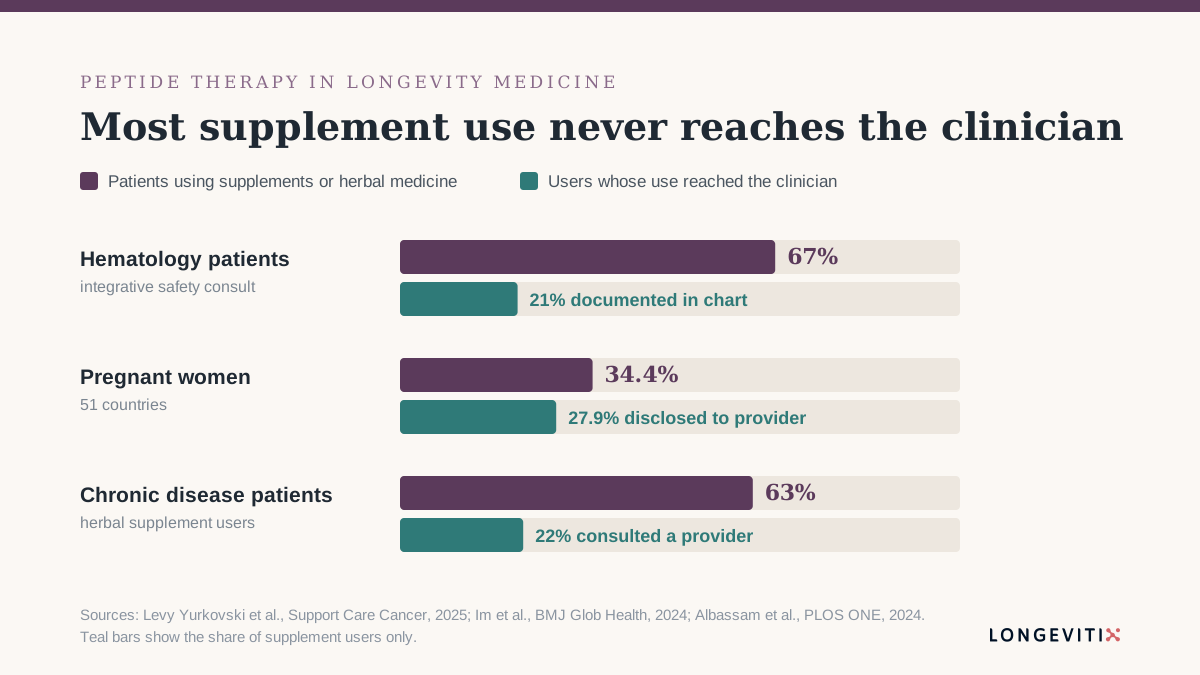
- In an integrative safety consultation series at a hematology institute, 67% of patients used dietary or herbal supplements. Only 21% of those patients had any of it documented at first consultation, and every documented item was a vitamin or mineral (Levy Yurkovski et al., Supportive Care in Cancer, 2025). None of the herbal or botanical products appeared in the chart.
- A systematic review covering 51 countries found that 34.4% of pregnant women used herbal medicine, and only 27.9% told their healthcare provider (Im et al., BMJ Global Health, 2024). A common reason was that nobody asked.
- Among patients with chronic disease, 63% used at least one herbal supplement and 78% had not consulted a healthcare provider about it (Albassam et al., PLOS ONE, 2024).
These are the products patients take by mouth and buy over the counter. Injected peptides, compounded hormones and research-grade compounds are harder to disclose and easier to leave off.
Why peptide documentation lags behind
Three things keep this information out of the structured record.
First, the data model. A typical EMR has no structured place for a peptide. A clinic can enter it as a free-text order, mention it in a note, or build a custom order set that only works inside that one clinic’s system.
Second, care is spread across offices. A patient may see a primary care physician, a longevity clinic and a dermatologist in the same month. Each office keeps its own list, and the lists rarely match.
Third, the intake question. “Are you taking any medications?” invites a list of prescriptions. Patients often don’t think of a peptide, a GLP-1 from a telehealth service, or a supplement stack as “medications.”
Why the structured medication list matters for safety
A free-text entry is invisible to every downstream check.
Interaction alerts run against structured drug entries. A peptide typed into a note never triggers one. Lab monitoring tied to a drug, such as IGF-1 checks for a growth hormone secretagogue, never gets scheduled. And when a patient changes clinics, a note-buried entry doesn’t travel with them.
There is also a liver signal. Herbal and dietary supplements are now a leading cause of drug-induced liver injury worldwide, and the AASLD practice guidance names them as a category clinicians must ask about (Fontana et al., Hepatology, 2023). That guidance exists because the chart so often leaves them out.
We wrote about the broader cost of fragmented records in why preventive medicine fails without data unification.
Making medication reconciliation for peptides routine
A clinic can close much of this gap without new software.
- Ask about prescriptions, over-the-counter products, supplements, hormones, peptides and anything injected, as separate items. Name GLP-1 telehealth services directly.
- Ask for photos. Product labels and pharmacy labels capture dose, form and source in seconds.
- Record each item with structure: compound, dose, route, frequency, start date, prescriber or source, and indication.
- Reconcile across offices. Ask which other clinicians the patient sees and what each one prescribed, and send your list to them.
- Repeat it every visit. Supplement and peptide stacks change faster than prescription lists.
The harder part is what happens after capture. A structured entry only helps if the system can reason about it: check interactions, schedule monitoring and connect it to the rest of the record. That is where most EMRs stop.
What changes when every intervention is structured
When peptides, hormones and supplements live in the same structured list as prescriptions, three things become possible.
The physician sees the full intervention set in one place. Interaction checks can include the supplement stack. And monitoring tied to each intervention can be scheduled as part of the plan.
At Longevitix, we treat every intervention as a structured entry with its own metadata, so the platform can surface interactions and monitoring needs for the physician to review. The physician decides what to act on. We described how this fits into day-to-day prevention work in software for personalized prevention plans.
Key takeaway
Patients take far more than the chart shows. The fix starts with asking better questions and recording the answers in a structured way, so every downstream safety check can see them.
FAQs
Why don’t patients disclose supplements?
Many don’t think of supplements or peptides as medications, and many are never asked. Asking about each category by name raises disclosure.
What should a supplement entry include?
Compound, dose, route, frequency, start date, source and indication. Without the source, you can’t judge quality or purity for compounded or online products.
Do supplements cause real harm?
Yes. Herbal and dietary supplements are a leading cause of drug-induced liver injury globally, and several common ones affect drug metabolism.
How often should we reconcile supplements?
At every visit. Longevity patients often add or drop products between appointments.
Can an EMR flag supplement interactions?
Only if the supplement is entered as a structured item. Free-text entries are invisible to interaction checks.