Back
BackSoftware for personalized prevention plans: a physician’s guide

Dr. Neil Panchal
Co-founder and Chief Medical Officer
Share:

Most patients leave a preventive visit knowing which screenings are due. Few leave with a plan built on their own risk, their own trends, and their own history. Physicians want to give them that plan. The time and the data rarely allow it.
When you search for software for personalized prevention plans, you find tools that each handle one part of the job. EHRs flag care gaps. Practice management tools store care plan templates. Risk calculators return a number. Each piece helps. They rarely connect into one plan a physician can review, adjust, and follow over time.
This guide sorts the options into four categories, explains what each one does well, and lists what to check before you choose.
Why preventive care needs its own software
The time math in preventive care has never worked. A 2021 study in the American Journal of Public Health estimated that delivering every USPSTF-graded preventive service to a panel of 2,500 adults would take 8.6 hours per working day. That is 131% of a physician’s available time, before any acute or chronic care.
Personalization adds to that load. A plan built for one patient means pulling data from several systems, running more than one risk assessment, and deciding which interventions apply to this person at this point in their trajectory.
Software can’t create more hours. It can remove the assembly work, so the hours you have go to judgment and conversation.
What a personalized prevention plan needs to contain
Before comparing tools, agree on the output. A usable plan covers five things:
➡️ Risk assessment across cardiovascular, cancer, metabolic, cognitive, and musculoskeletal domains, with the inputs that drove each estimate.
➡️ A screening schedule adjusted to the person. Population intervals are the starting point. Family history, prior findings, and genetics move dates earlier or add tests.
➡️ Targets for modifiable markers such as ApoB, HbA1c, blood pressure, VO₂ max, body composition, and sleep, each set for this patient’s risk level.
➡️ Possible interventions (lifestyle, pharmacologic, referral), each linked to the source that supports it.
➡️ A follow-up cadence: when to recheck, and which change in data should trigger a review before that date.
Population guidelines set the floor. Personalization adjusts the plan above that floor for one patient.
The four categories of prevention plan software
Software that claims to support preventive care falls into four groups. Most clinics already use at least two.
1. EHR care gap tools and clinical decision support
This is the category most physicians know. Epic’s Healthy Planet module uses EHR data to find care gaps and bundle orders for colon and lung cancer screening, vaccines, and counseling. Its BestPractice Advisories prompt clinicians when a service is due. athenaOne surfaces preventive care alerts and care gaps inside the visit workflow and now adds AI-assisted outreach. MEDITECH Expanse offers similar health maintenance and population health features.
What they do well:
- They sit inside the chart, so there is no extra login
- They track quality measures and payer requirements
- They work across thousands of patients at once
Where they stop:
- They answer one question: is this patient overdue for a guideline-based service?
- They rarely ingest wearables, advanced lipid panels, or imaging from outside the system
Care gap tools are essential for quality reporting. They were built to close gaps against population rules. Building a multi-domain plan for one patient is a different task.
2. Care plan and practice management tools
Platforms such as Carepatron give smaller practices care plan templates, clinical notes, scheduling, and a patient portal in one place.
What they do well:
- Fast setup and low cost
- Templates help a clinic standardize how plans look
- Patients can see their plan and message the team
Where they stop:
- The plan is a document, and the physician writes all of the clinical logic
- Risk calculation and data trends live elsewhere
- Updating a plan when new labs arrive is manual work
3. Standalone risk assessment calculators
Validated calculators remain the backbone of preventive risk assessment. The AHA PREVENT equations estimate 10-year cardiovascular risk for ages 30 to 79 and 30-year risk for ages 30 to 59. They add eGFR and BMI as inputs and accept HbA1c and urine albumin-to-creatinine ratio. The Breast Cancer Risk Assessment Tool and FRAX fill similar roles for breast cancer and fracture risk.
What they do well:
- Validated in large cohorts
- Free and widely accepted by specialists and payers
Where they stop:
- Each covers one domain
- Inputs are typed by hand, and outputs often stay outside the chart
- Each run is a single snapshot. A second run a year later gives a new number with no view of the path between the two
4. Dedicated preventive care platforms
The newest category starts from the individual patient. These platforms unify EHR records, labs, wearables, imaging, and genetic results. They run risk models across domains, track each marker over time, and draft a prevention plan for physician review.
What they do well:
- One longitudinal view of all patient data
- Risk assessment across several domains at once
- Plans that update as new data arrives
Where they stop:
- They are newer, so evaluation matters more. Ask how each suggestion is grounded and who signs off
Longevitix sits in this category. I’ll cover how it works below.
Quick comparison
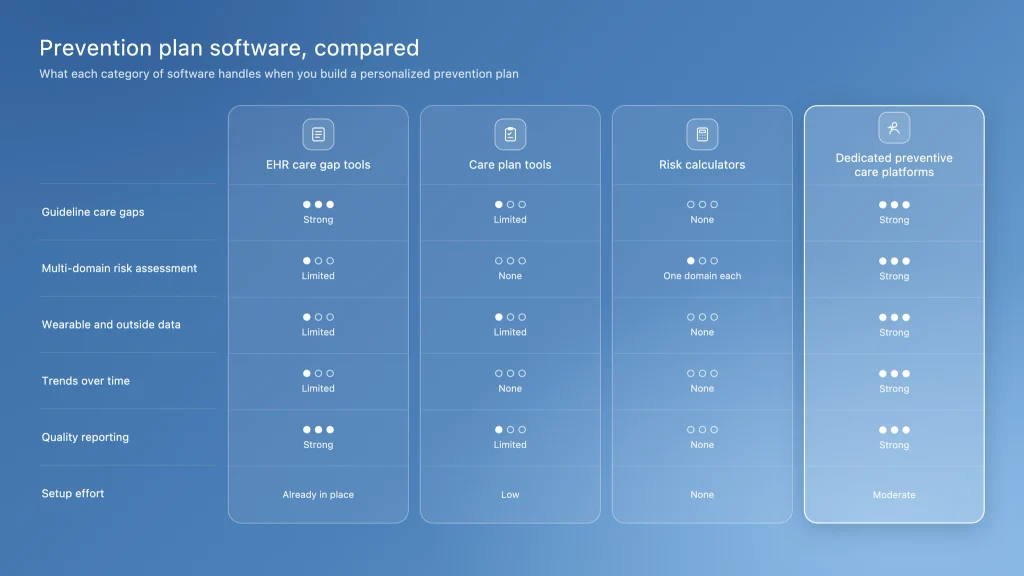
| Need | EHR care gap tools | Care plan tools | Risk calculators | Dedicated preventive care platforms |
|---|---|---|---|---|
| Guideline care gaps | Strong | Limited | None | Strong |
| Multi-domain risk assessment | Limited | None | One domain each | Strong |
| Wearable and outside data | Limited | Limited | None | Strong |
| Trends over time | Limited | None | None | Strong |
| Quality reporting | Strong | Limited | None | Strong |
| Setup effort | Already in place | Low | None | Moderate |
Care gaps and personalized prevention answer different questions
A care gap is a deviation from a population rule. A personalized prevention plan starts from one patient’s risk and trajectory. The two overlap, and they split furthest apart in patients who look healthy.
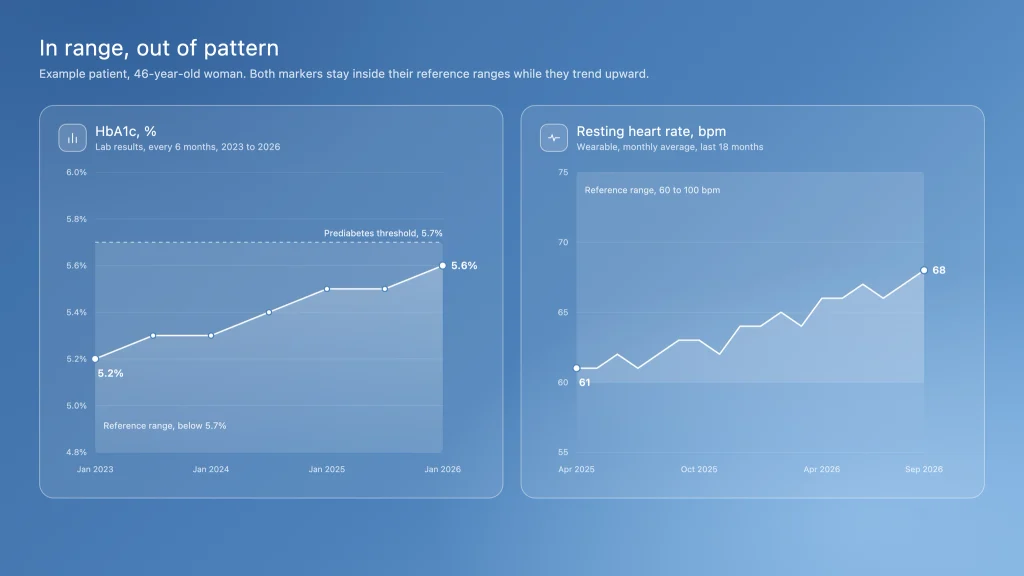
Consider a 46-year-old woman. Her LDL is 118 mg/dL. Her blood pressure is normal. Her mammogram and Pap are current. In a care gap view, her chart is clean.
Pull the rest of her data into one place and a pattern appears:
➡️ An Lp(a) of 190 nmol/L, measured once four years ago and never acted on
➡️ A mother who had a myocardial infarction at 57
➡️ HbA1c that moved from 5.3% to 5.8% over three years
➡️ A resting heart rate on her wearable that rose 7 bpm over 18 months
None of these values triggers an alert alone. Each sits inside a reference range or outside the scope of a quality measure. Together they describe a patient whose cardiometabolic risk is climbing. She is in range and out of pattern.
Prevention plan software is most useful in that space. I wrote more about why it depends on pulling data together in why preventive medicine fails without data unification.
What to look for in clinical decision support for preventive care
If you are evaluating software to build personalized prevention plans, check these eight things.
➡️ Data breadth. Can it ingest EHR data, outside labs, wearables, imaging reports, and genetic results? Does it normalize units and reference ranges across labs?
➡️ Longitudinal view. Does it show how each marker moved over time, or only the latest value?
➡️ Evidence transparency. When it flags something, can you see the source? Grounding in curated clinical databases matters here. Our posts on deterministic and probabilistic AI and retrieval-augmented generation explain why.
➡️ Physician control. Does a physician review, edit, and approve every suggested intervention before it reaches the patient?
➡️ Clinic customization. Can you encode your own clinic’s protocols? Customization happens at the clinic level and personalization at the patient level. Good software supports both.
➡️ Alert discipline. Does it rank what matters, or add more interruptions to a crowded inbox?
➡️ Follow-up loop. Does the plan update when new data arrives? Can you track whether patients reach their targets?
➡️ EHR fit. Does it work alongside your existing EHR and its care gap tools, and can it write back to the chart?
For a deeper checklist on the data side, see what belongs in a clinical data integration evaluation.
How Longevitix supports personalized prevention plans
Longevitix is operational infrastructure for preventive medicine. We built it because the plans I wanted for my patients needed data from six systems and an hour of assembly per patient.
Here is how a plan comes together on the platform:
- EHR records, lab results, wearable data, imaging, and genetic results flow into one longitudinal patient record.
- AI decision support runs risk assessment across cardiovascular, cancer, metabolic, and other domains. Every finding links to its source in curated clinical databases.
- The platform drafts a prevention plan with targets, a screening schedule, and possible interventions, using the clinic’s own protocols.
- The physician reviews each item, edits, removes, or adds, and signs off. Where data is missing, the platform flags the gap and involves the physician before proceeding.
- As new results arrive, the platform surfaces changes in trajectory and flags items for physician review. Outcome analytics show how patients progress against their targets.
The physician makes every clinical decision. The platform handles assembly, tracking, and evidence lookup.
EHR care gap tools still belong in the setup. They handle quality reporting well, and most clinics should keep them. Longevitix adds a dedicated preventive care layer above them. For the operational side of running this at scale, read how to operationalize personalized longevity care in a clinic.
FAQs
What is the best software for doctors to build personalized prevention plans? It depends on the job. For guideline care gaps and quality measures, use your EHR’s clinical decision support. For multi-domain plans that draw on labs, wearables, and imaging over time, look at a dedicated preventive care platform such as Longevitix. Most clinics run both.
Can my EHR build a personalized prevention plan? Partly. Epic, athenahealth, and MEDITECH flag overdue screenings and vaccines well. Most EHRs don’t combine outside labs, wearables, and multi-domain risk assessment into one plan, so physicians fill that gap by hand.
How is clinical decision support for preventive care different from a risk calculator? A calculator returns one risk estimate for one domain from the inputs you type. Decision support pulls inputs from the record, runs several assessments, tracks changes over time, and flags items for physician review.
What data should a personalized prevention plan include? At minimum: a lipid panel with ApoB and Lp(a), HbA1c, blood pressure, kidney function, family history, and current screening status. Wearable data, coronary calcium scoring, and genetic results add precision when available.
Does AI decision support make clinical decisions? The physician makes every clinical decision. AI decision support surfaces patterns, evidence, and possible interventions. The physician reviews, adjusts, and approves the plan.
How often should a prevention plan be updated? Review it at least once a year and whenever new data shifts risk. A new lab result, a change in family history, or a sustained trend in wearable data should prompt a review before the scheduled date.