Back
BackWhat Is RAG (Retrieval-Augmented Generation) — And Why It Makes Clinical AI Safer

Effie Arditi
Co-Founder & CEO
Share:

Here is a question every physician should ask before trusting any AI-generated clinical recommendation: Did the system retrieve this from a verified source, or did it generate it from memory?
The difference matters. In clinical settings, it may be the difference between a safe recommendation and a confident hallucination. This is where Retrieval-Augmented Generation, or RAG, enters the picture. It is one of the most consequential architectural decisions in clinical AI today, and most physicians have never heard of it.
Where Standard LLMs Break Down
Large language models like GPT-4, Claude, and Gemini encode knowledge into billions of parameters during training. When you ask a question, the model generates a response based on those stored patterns. This works for general knowledge tasks. It breaks down in medicine.
Medical knowledge changes constantly. Guidelines are revised. Drug interactions are updated. New trials shift the evidence base on interventions that were standard-of-care six months ago. A model trained through a fixed cutoff date has no awareness of what changed after that date. It will still generate an answer, and it will sound confident, but it may be wrong in ways that are clinically dangerous.
A 2025 study published on medRxiv found that LLMs routinely produce fabricated citations, invent drug dosages, and generate treatment recommendations not supported by current evidence. The models did not flag uncertainty. They presented hallucinated content with the same fluency as accurate content.
What RAG Actually Does
RAG changes the fundamental architecture. Instead of relying on what the model “remembers” from training, a RAG system retrieves relevant information from external knowledge sources at the time of the query, then uses that retrieved context to generate its response.
Think of it this way: a standard LLM is a physician answering from memory. A RAG-enabled system is a physician who pulls up the latest clinical guidelines, checks the relevant trials, and reviews the patient’s records before responding.
The system receives a query, searches a curated knowledge base (peer-reviewed literature, clinical practice guidelines, formularies, institutional protocols, or a patient’s longitudinal health data), and generates a response grounded in the retrieved documents with the ability to cite its sources. A systematic review in JAMIA (2025) confirmed that RAG consistently improved factual accuracy and reduced hallucination compared to standalone LLMs, and established clinical development guidelines noting source traceability as a core safety advantage.
Why RAG Is a Safety Architecture, Not a Feature
The clinical safety case for RAG rests on three properties that standard LLMs lack.
Source traceability. When a RAG system generates a recommendation, the underlying retrieved documents are accessible. A physician can trace a dosing suggestion back to a specific guideline, a risk stratification back to a specific study. With a standard LLM, the answer emerges from a black box of compressed training data with no way to verify where it came from.
Knowledge currency. A RAG system’s knowledge base can be updated continuously without retraining the entire model. When a guideline is revised or a drug label changes, the knowledge base reflects that change immediately. Fine-tuned models encode knowledge at training time. Updating them requires expensive retraining that risks degrading performance on previously learned tasks.
Retrieval confidence thresholds. Well-designed RAG systems include confidence scoring on retrieved documents. If the system cannot find sufficiently relevant source material, it flags that gap rather than generating a plausible-sounding but ungrounded answer. A system that knows when it doesn’t know is far safer than one that always produces an answer.
Research backs this up. A 2025 evaluation of RAG variants for clinical decision support found that SELF-RAG achieved hallucination rates as low as 5.8%. A separate framework called MEGA-RAG reduced hallucinations by over 40% through multi-evidence validation. In clinical environments where a single fabricated dosage could cause harm, these reductions represent the difference between a useful tool and a liability.
RAG in Preventive and Longevity Medicine
The safety advantages of RAG become especially pronounced in preventive medicine, where the knowledge landscape is broader, more dynamic, and less standardized than conventional care. A physician evaluating the evidence on NAD+ precursors for a patient with early metabolic dysfunction needs to cross-reference genetic data, consider medication interactions, and weigh evidence across RCTs, observational studies, and emerging fields like senolytics and epigenetic reprogramming. No static model trained at a fixed point in time can reliably cover that ground.
A growing number of clinical AI platforms are tackling pieces of this challenge, from wearable and lab data aggregation to risk prediction models trained on longitudinal patient records, to AI co-pilots for functional medicine workflows. Some have demonstrated meaningful safety gains in physician-AI collaboration, with research showing clinical error rates dropping significantly when AI-assisted workflows are used alongside physician judgment. The shared challenge across all of them is ensuring that AI outputs are grounded in verifiable, current evidence rather than in the probabilistic memory of a language model.
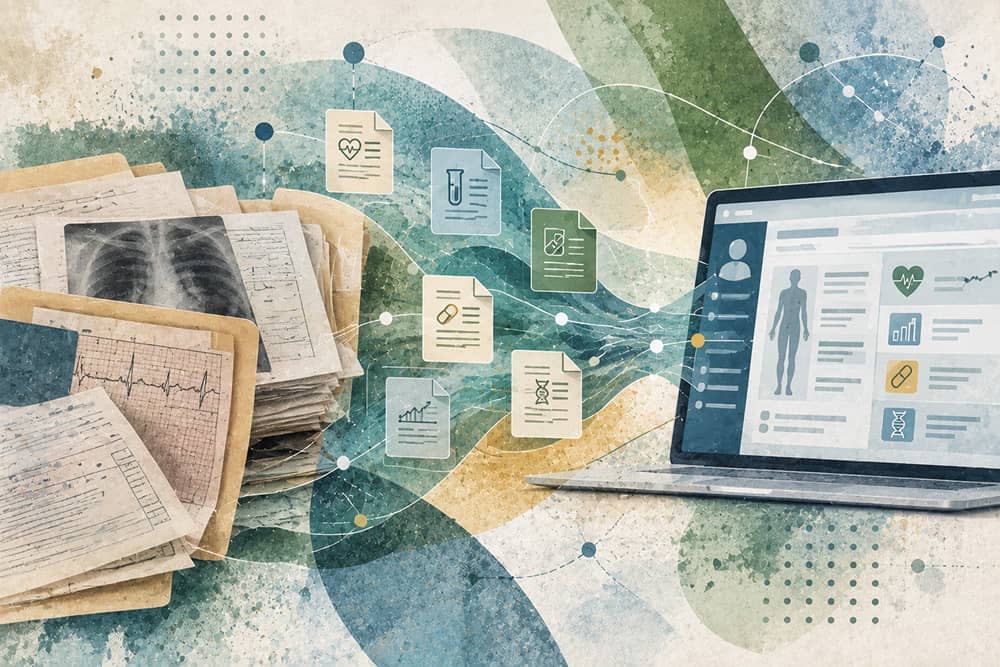
At Longevitix, RAG is not a feature we bolted on. It is a foundational architectural decision. Our clinical intelligence platform unifies multi-modal patient data (genetics, epigenetics, microbiome, imaging, biometrics, EHRs, wearables, specialty labs, and longitudinal patient histories) into a single hub. Every recommendation, risk stratification, and intervention plan is generated with real-time retrieval from curated clinical knowledge bases spanning published research, clinical practice guidelines, and the full depth of longevity medicine literature. Every output is traceable to its source and fully editable by the physician.
We also built deterministic guardrails around the probabilistic outputs: rule-based safety constraints that prevent the system from recommending contraindicated interventions or deviating beyond established clinical boundaries, regardless of what the language model generates. If the system fails, it fails safely, with full traceability into why. The physician remains the final decision-maker. The system handles the complexity of sourcing, synthesizing, and citing the evidence.
RAG vs. Fine-Tuning: What Clinicians Should Know
Fine-tuning retrains a model on domain-specific medical data, producing strong clinical fluency but freezing knowledge at training time with no source traceability. RAG keeps the model connected to external, updatable knowledge sources, grounding outputs in retrievable, citable evidence. A 2025 scoping review in Bioengineering found that hybrid systems combining both (FT+RAG) consistently outperformed either approach alone across clinical question-answering, summarization, and decision support. This is the direction clinical AI is heading: deep medical reasoning paired with real-time, source-verified knowledge retrieval.
A comprehensive review in AI journal (2025) mapped this trajectory and found the field moving toward multimodal retrieval, where systems retrieve and reason across text, imaging, structured data, and sensor inputs simultaneously. RAG gives clinical AI something standard LLMs fundamentally lack: the ability to show its work. For physicians practicing at the intersection of complex data and evolving evidence, that capability is not incremental. It is the baseline requirement for trust.
Frequently Asked Questions
What is RAG (Retrieval-Augmented Generation) in healthcare?
RAG is an AI architecture that combines a large language model with a real-time retrieval system connected to external knowledge sources such as clinical guidelines, peer-reviewed literature, drug databases, and patient records. Instead of generating answers from training memory, a RAG system looks up relevant evidence at query time and grounds its response in that retrieved information, making outputs more accurate, current, and traceable to their sources.
Why is RAG safer than a standard LLM for clinical use?
Standard LLMs generate responses from patterns learned during training with no mechanism to verify accuracy against current sources. They can produce hallucinations with no indication of uncertainty. RAG systems ground outputs in retrieved documents, allow source tracing, and can flag low-confidence scenarios rather than generating unverifiable answers.
How does RAG reduce AI hallucinations in medicine?
RAG anchors language model output to specific retrieved documents rather than allowing free generation from training data. Advanced variants like SELF-RAG achieve hallucination rates as low as 5.8%, while MEGA-RAG reduces hallucinations by over 40% through multi-evidence validation.
What is the difference between RAG and fine-tuning in clinical AI?
Fine-tuning retrains a model on medical data, improving fluency but freezing knowledge at training time with no source traceability. RAG connects a model to updatable knowledge bases for real-time evidence retrieval and citation. Research found that combining both (FT+RAG) outperforms either alone across clinical summarization, question-answering, and decision support.
Can RAG-based clinical AI replace physician judgment?
No. RAG systems surface, synthesize, and cite evidence so physicians can make more informed decisions. The physician remains the final decision-maker. Well-designed systems make every output editable and include deterministic safety guardrails preventing contraindicated recommendations regardless of what the language model generates.
What should physicians ask when evaluating RAG-based AI tools?
Key questions: Does the system retrieve evidence at query time or generate from training memory? Can you see sources behind each recommendation? How frequently is the knowledge base updated? How does the platform handle low-confidence scenarios? Are there deterministic safety constraints on outputs?