Back
BackReading the Skin as Systemic Data

Dr. Neil Panchal
Co-founder and Chief Medical Officer
Share:
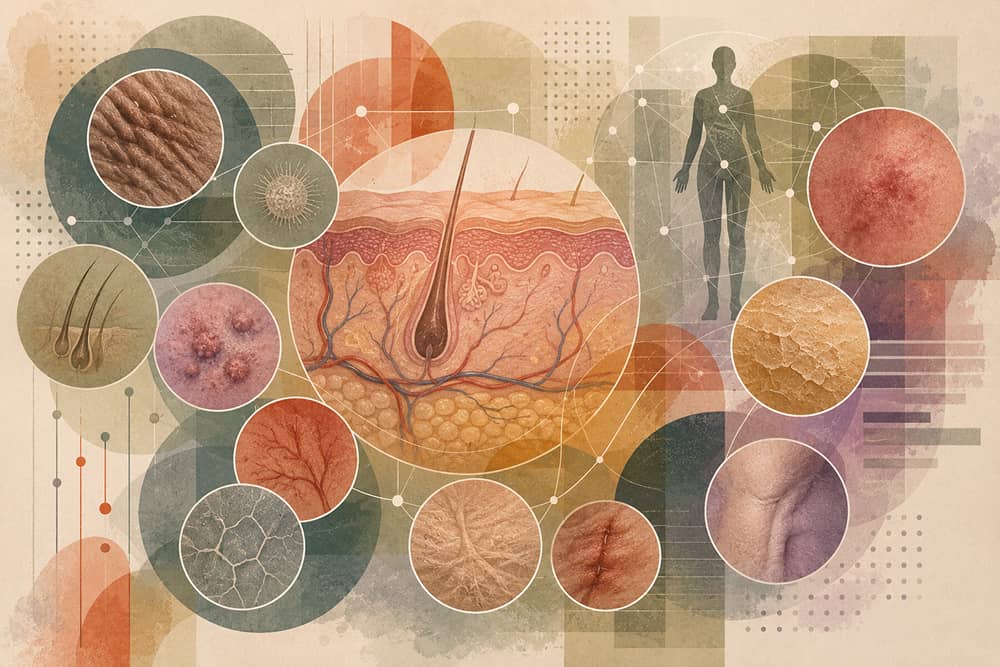
A patient books for acne at forty-three. Another mentions, almost in passing, that her hair has been thinning for a year. A third has velvety darkening in the axillae that she assumes is a hygiene problem and has not mentioned to anyone.
Three dermatological presentations. None of them are, in the useful sense, a skin problem.
The organ we can actually watch
Skin holds an unusual position in the assessment of aging. It is the only organ in which the molecular, structural and functional changes of aging can be directly visualised, measured and tracked longitudinally in a living person. Everything else requires a proxy.
That accessibility is why a body of work has developed over the past two years arguing for dermatology as a translational bridge between geroscience and clinical practice. A 2026 review in the Journal of Cosmetic Dermatology sets out the case in detail: mitochondrial efficiency, cellular senescence and systemic inflammatory tone are among the principal determinants of biological ageing across tissues, and each of them is implicated in skin ageing specifically. The mechanisms are shared. The skin is simply the place they become visible.
Findings and the systems behind them
| Cutaneous finding | Systemic process worth considering | Sensible next step |
|---|---|---|
| Acanthosis nigricans | Insulin resistance, often years before glycaemic change | Fasting insulin with glucose, HbA1c, lipid panel with ApoB |
| Adult-onset or persistent acne in women | Androgen excess, PCOS, perimenopausal hormonal shift | Cycle history, androgen profile if indicated, metabolic screen |
| Female pattern hair loss | Iron deficiency, thyroid disease, androgen excess, chronic caloric restriction | Ferritin with transferrin saturation, TSH and free T4, full blood count, dietary history |
| Chronic urticaria | Autoimmune activity, thyroid autoimmunity | Thyroid function with antibodies, targeted autoimmune screen |
| Rosacea | Vascular reactivity, gut-skin signalling, inflammatory tone | Trigger history, gastrointestinal review, cardiovascular risk assessment |
| Xerosis with pruritus in an older adult | Thyroid disease, renal impairment, cholestasis, medication effect | Thyroid function, renal and hepatic profile, medication review |
| Delayed wound healing | Glycaemic control, protein status, peripheral perfusion | HbA1c, nutritional assessment, vascular examination |
| Skin laxity out of proportion to age | Rapid weight loss, sarcopenia, nutritional deficit | Body composition assessment, protein intake, resistance training history |
None of these associations is new. What has changed is the availability of a framework for treating them as data rather than as incidental observations, and the willingness of the field to formalise the connection.
The biomarker layer
Beyond clinical inspection, the 2026 literature describes a set of measurable markers of cutaneous ageing that correlate with systemic processes: epigenetic clocks applied to skin tissue, inflammatory signatures, mitochondrial and metabolic markers, and skin microbiome profiling.
The microbiome work has produced the most specific findings so far. Moraxella osloensis has been identified as a microbial marker of premature ageing, with experimental work showing it promotes collagen catabolism and cellular senescence. Cutibacterium acnes, by contrast, is associated with delayed ageing and with maintenance of barrier integrity, which sits awkwardly alongside its reputation in acne pathogenesis and is a reminder that organism-level associations rarely reduce to good or bad.
What this does not yet support
Most longevity-oriented dermatological diagnostics remain at an early or experimental stage and require rigorous validation before routine clinical adoption. That statement comes from the reviews advocating for the field, not from its critics, which is a good sign about the seriousness of the work.
The practical implication is a division. Findings-to-systems reasoning, the content of the table above, is well established and immediately usable. Skin-derived epigenetic clocks and microbiome profiling are legitimate research tools whose clinical thresholds have not been established, and selling them as diagnostics ahead of that evidence damages the credibility of the whole area.
Lifestyle factors sit somewhere in between. A 2026 review in Frontiers in Aging examining the six pillars of lifestyle medicine against the biology of skin ageing finds mechanistic support that is considerably stronger than most patients expect and considerably weaker than most marketing claims.
Recording skin so it becomes usable
The barrier to treating skin as longitudinal data is that skin findings are recorded as prose, buried in a note, and effectively unretrievable a year later.
Three changes make a difference. Record findings as discrete observations with a date rather than as narrative. Photograph consistently, with the same lighting and framing, since a comparison across two years is worth more than any description. Attach the systemic question you considered, so that a future clinician can see the reasoning rather than only the observation.
Structured capture of this kind is one of the more mundane things Longevitix does and one of the more useful. Clinical observations, photographic records, laboratory values and wearable-derived trends are held in a single longitudinal record, so a dermatological finding noted in March sits alongside the fasting insulin drawn in September rather than in a different system entirely. The connection between the two is the clinical insight, and it only becomes available when both are in the same place.