Back
Back
How Clinics Integrate EHR, Labs, and Wearables for Preventive Care

Effie Arditi
Co-Founder & CEO
Share:
Why most preventive care clinics fail at integrating EHR, lab, and wearable data, and what the infrastructure solution to make this happen actually looks like.
Every preventive medicine clinic collects data from electronic health records, labs, and wearables, yet almost none of them can see that data in one place.
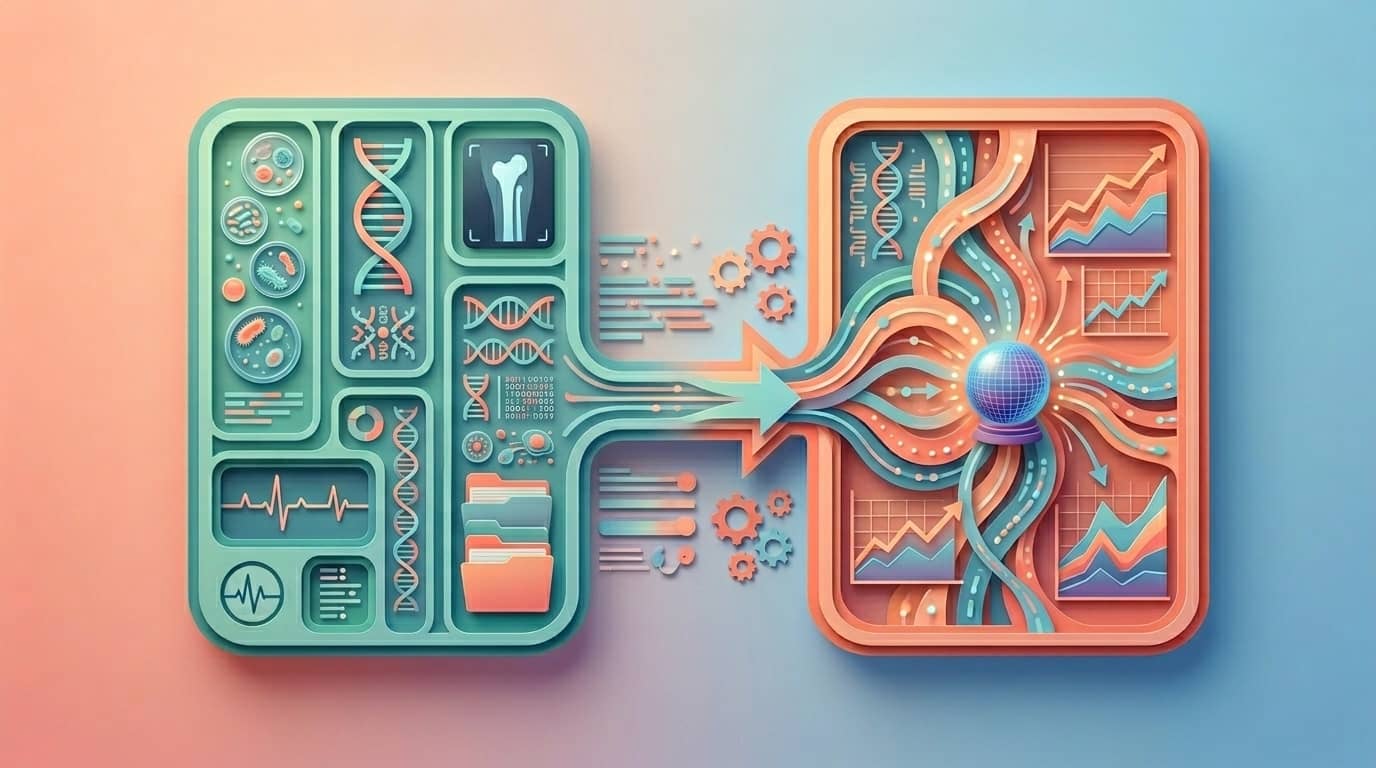
Integrating EHR, lab, and wearable data for preventive care means building a unified data layer that connects a patient’s clinical history, biochemical markers, and continuous physiological signals into a single longitudinal view. It’s the foundational infrastructure that turns fragmented health snapshots into a trajectory on which a physician can actually act.
I talk to physicians and clinic operators every week. The pattern is consistent: they have an EHR for charting, a separate lab portal, a wearable dashboard nobody checks, maybe a spreadsheet for supplement protocols. Each one works in isolation. Together, they create a manual assembly job that burns hours and misses the connections that matter most.
This isn’t a data collection problem. Clinics have more data than ever. It’s a data synthesis problem, and it’s often the reason preventive care can’t scale.
The Three Data Streams (and Why Nobody Built Them to Work Together)
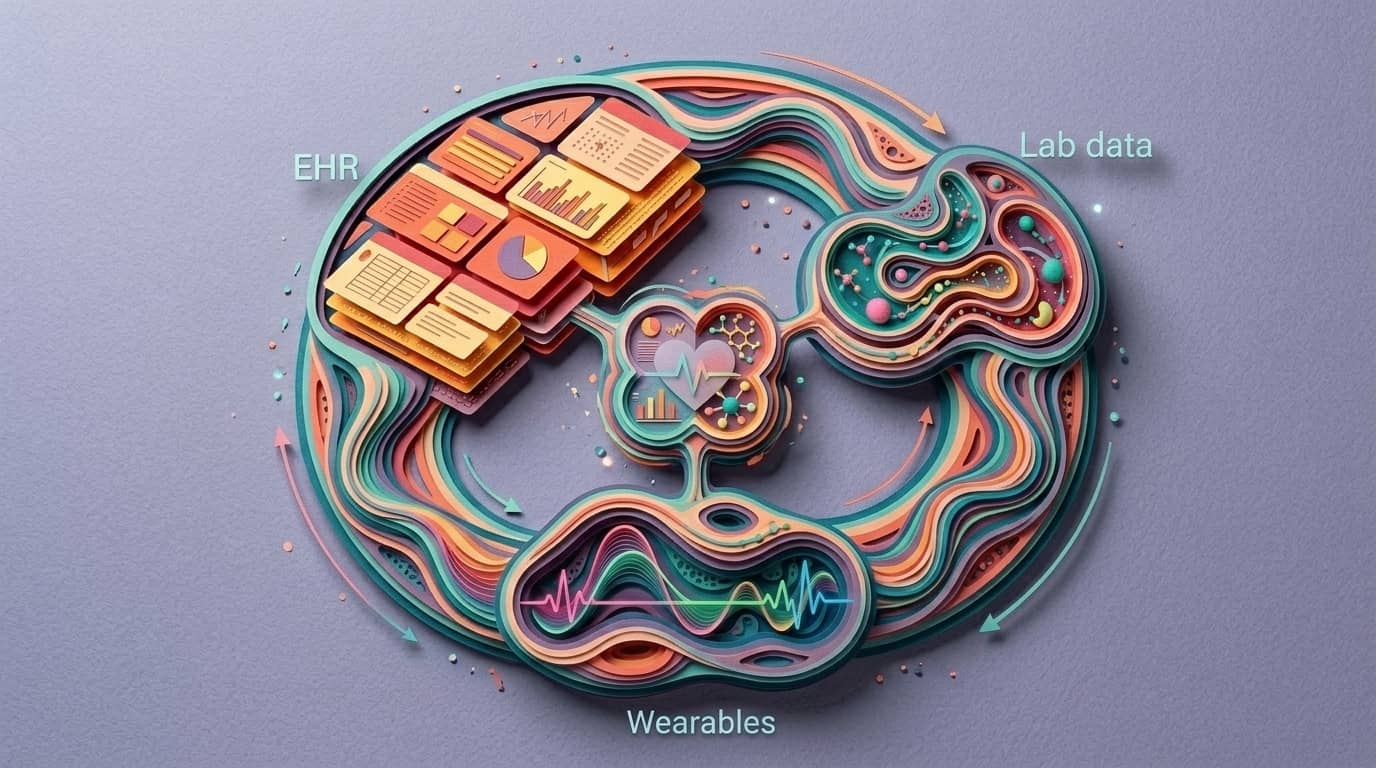
Preventive care depends on three types of patient data:
1. EHR data: medical history, diagnoses, medications, imaging, visit notes. The clinical backbone.
2. Lab data: blood panels, metabolomics, hormonal profiles, inflammatory markers. The biochemical layer.
3. Wearable data: continuous heart rate, HRV, sleep architecture, activity patterns, glucose trends. The signal between visits.
In traditional reactive medicine, you only needed the first two. In preventive medicine, you need all three, connected and contextualized.
The problem is structural. These systems were built by different companies, for different purposes, in different decades:
- EHRs were designed for billing and documentation, not longitudinal tracking. Their data model optimizes for encounter-based records, not time-series analysis.
- Lab results arrive as static PDFs or discrete values from third-party reference labs. No native connection to the EHR. No trend visualization.
- Wearable data generates thousands of data points per day, but only about 10% of physicians currently integrate it into their EHR systems.
The result: every patient visit starts with a physician manually piecing together the story from fragmented sources. We interviewed 50 preventive medicine clinics about this problem. It was the number one operational bottleneck. A single comprehensive patient analysis can take 5 to 10 hours when you’re pulling from 8+ disconnected sources.
What Integration Actually Looks Like When It Works
The clinics doing this well aren’t adding more dashboards. They’re building (or adopting) a data layer that sits between their sources and their clinical decision-making.
Three things have to happen:
1. Unified Ingestion
All three data streams feed into a single platform. Lab results arrive via direct integrations or structured uploads. Wearable data flows through APIs (Apple HealthKit, Garmin Health, Oura, CGMs). EHR data syncs through FHIR-based APIs, the interoperability standard now backed by CMS mandates.
The non-negotiable: standardized formats. LOINC codes for lab values. FHIR resources for clinical data. Normalized units for wearable metrics. Without standardization, you’re aggregating noise.
2. Clinical Contextualization
Raw data isn’t useful on its own. A resting heart rate of 58 bpm means nothing in isolation.
But resting heart rate trending from 54 to 62 over eight weeks, alongside rising hsCRP, declining HRV, and a new sleep fragmentation pattern? That tells a story. A physician can see subclinical stress developing before anything hits a diagnostic threshold.
This is where the value of integration becomes concrete:
- Lab values plotted as trends over months and years, not point-in-time snapshots.
- Wearable patterns contextualized against lab results. For example, glycemic volatility from a CGM correlated with fasting insulin trends on bloodwork.
- EHR history providing the clinical frame (medication changes, protocol adjustments, family history) that gives meaning to the numbers.
I wrote about this more broadly in What Becomes Possible When a Physician Has Every Data Point in One Place. The short version: integration turns isolated data into clinical intelligence.
3. Physician-Governed Alerts
The goal isn’t to flood clinicians with data. It’s to surface what matters.
Good systems use clinically defined thresholds, not factory defaults, to flag meaningful deviations. A physician should be able to say: “Alert me if this patient’s HRV 7-day average drops below their personal baseline by more than 15%, concurrent with a sleep efficiency drop.”
That’s actionable. What’s not useful: 10,000 daily heart rate readings dumped into the EHR.
As explored in Your Apple Watch Data Needs a Doctor, the difference between consumer wellness data and a clinical signal is governance. Physician oversight turns noise into insight.
The FHIR Standard: Progress, but Not the Whole Solution
The CMS Interoperability and Prior Authorization Final Rule (CMS-0057-F) is pushing FHIR adoption forward, with compliance deadlines in 2026 and 2027. The healthcare interoperability solutions market is projected to grow from $4.37 billion in 2025 to $15.13 billion by 2035. The U.S. Department of Health and Human Services has allocated $850 million toward healthcare interoperability programs. The investment is real.
But here’s what I think most people miss: FHIR solves data exchange. It doesn’t solve data interpretation.
You can move a lab result from Quest Diagnostics into an EHR via FHIR. That’s progress. But:
- Does the system flag that this patient’s LDL-P has been climbing 8% per quarter for two years?
- Does it correlate that trend with declining VO2 max from wearable data?
- Does it surface this to the physician before the next visit, not after?
Interoperability standards are the plumbing. Clinics still need the intelligence layer that turns connected data into clinical insight. That’s the infrastructure gap we’re building Longevitix to close.
FHIR Interoperability vs Full Clinical Integration: What’s the Difference?
| FHIR Interoperability | Full Clinical Integration | |
|---|---|---|
| What it does | Moves data between systems in a standard format | Unifies, contextualizes, and analyzes data across sources |
| Data types | Primarily clinical/EHR and claims data | EHR + labs + wearables + genomics + patient-reported |
| Temporal view | Episodic (encounter-based) | Longitudinal (trajectory over time) |
| Intelligence | None. Data exchange only. | Pattern recognition, trend detection, clinical alerts |
| Physician burden | Lower (data is accessible) | Significantly lower (data is interpreted) |
| Requires AI | No | Yes (clinically governed) |
| Current maturity | Mandated by CMS, widely adopted | Early stage. Most clinics lack this layer. |
Four Mistakes Clinics Make With Data Integration
After years of conversations with physicians and clinic operators, I keep seeing the same patterns.
Mistake 1: Treating wearable data like lab data. Wearable data is continuous, noisy, and context-dependent. It can’t be reviewed the same way as a CBC. Clinics need aggregation logic (rolling averages, trend extraction, deviation detection) before wearable data reaches a clinician’s screen. Without that layer, it’s unusable at scale.
Mistake 2: Adding more tools instead of a data layer. Every new lab partnership, wearable integration, or AI tool adds another silo unless there’s a unifying platform underneath. I’ve seen clinics with seven dashboards and zero synthesis. More dashboards does not equal more insight.
Mistake 3: Skipping the clinical governance layer. AI can flag patterns. Algorithms can detect trends. But someone has to decide what’s clinically meaningful and what’s noise. That requires physician-defined protocols, not black-box scoring. As discussed in Beyond the Algorithm, the value of AI in this space is what it surfaces for human review, not what it decides autonomously.
Mistake 4: Ignoring the workflow impact. A technically elegant integration that adds 20 minutes to every patient visit isn’t an improvement. Data must flow into existing clinical workflows (visit prep, consult summaries, patient communications) or it simply won’t get used. The best technology is the kind that disappears into the workflow.
Why This Is an Infrastructure Problem, Not a Technology Problem
There’s no shortage of health data technology. Wearable companies, lab platforms, EHR vendors, AI startups. They all exist. What doesn’t exist, for most clinics, is the connective tissue.
The healthcare system was never designed for prevention. Reimbursement models reward treatment. EHRs optimize for billing documentation. Lab systems were built for one-time diagnostic queries, not longitudinal tracking.
Venture capital involvement in health tech integration has increased by 42%, particularly in startups offering remote monitoring and wearable tech integrations. Approximately 61% of healthcare investors are now prioritizing funding for telehealth, mobile health, and AI-integrated clinical decision platforms. The money is flowing. But most of it is going toward point solutions, not unified infrastructure.
The clinics that will define the next era of preventive care aren’t the ones with the most data sources. They’re the ones that figured out how to make all those sources work together, inside a workflow a physician can actually use, without burning hours on manual synthesis.
That’s the problem worth solving. And it’s what we spend every day working on.
Frequently Asked Questions
What does EHR integration mean for preventive medicine clinics?
EHR integration in preventive medicine means connecting electronic health records with lab systems, wearable devices, and clinical decision tools so physicians can view a patient’s complete health trajectory in one place. For preventive clinics specifically, this is critical because they track trends over time rather than diagnosing conditions at a single visit.
Why can’t most clinics integrate wearable data into their EHR systems?
Most EHR systems were built for encounter-based documentation and billing, not for continuous time-series data. Wearable data generates thousands of data points daily and requires middleware that aggregates, normalizes, and filters before it enters the clinical record. Only about 10% of physicians currently have this integration in place.
What is FHIR and why does it matter for preventive care data integration?
FHIR (Fast Healthcare Interoperability Resources) is a standard for exchanging healthcare data electronically. It allows different systems (EHRs, lab platforms, wearable apps) to share data in a common format. CMS mandates are accelerating adoption through 2026-2027 compliance deadlines. However, FHIR handles data exchange, not data interpretation, so clinics still need an intelligence layer on top.
How much is the healthcare interoperability market worth in 2026?
The global healthcare interoperability solutions market was valued at $4.37 billion in 2025 and is projected to reach $15.13 billion by 2035, growing at a 13.8% CAGR. The U.S. Department of Health and Human Services has allocated $850 million toward interoperability programs. Venture capital involvement has increased 42%, focused on remote monitoring and AI-integrated clinical platforms.
What is the difference between FHIR interoperability and full clinical integration?
FHIR interoperability moves data between systems in a standardized format. Full clinical integration unifies, contextualizes, and analyzes data across multiple sources (EHR, labs, wearables, genomics) to surface longitudinal trends and clinically meaningful patterns. FHIR is necessary plumbing; full integration adds the intelligence layer that makes the data clinically actionable.
Why is data synthesis the biggest bottleneck for scaling preventive care?
Most preventive care requires manually consolidating data from 8+ sources per patient. A single comprehensive analysis can take 5-10 hours. Without automated integration, clinics hit a ceiling on how many patients they can serve. The bottleneck isn’t collecting data. It’s making sense of it fast enough to act on it.
What should a clinic look for in a data integration platform?
Prioritize: FHIR compatibility, direct lab integrations, wearable API support (Apple HealthKit, Garmin, Oura, CGMs), longitudinal biomarker tracking, customizable clinical alerts with physician-defined thresholds, and workflow integration that fits into visit prep and consult summaries. Avoid platforms that add dashboards without a unifying data layer underneath.
Can AI help physicians integrate health data from multiple sources?
Yes, but with guardrails. AI adds value by identifying patterns across data streams that manual review can’t catch at scale. But in healthcare, AI must operate under physician governance: traceable recommendations, editable outputs, transparent logic. The physician decides what’s signal and what’s noise. AI handles the assembly.