Back
Back
What Becomes Possible When a Physician Has Every Data Point in One Place
Dr. Neil Panchal
Co-founder and Chief Medical Officer
Share:
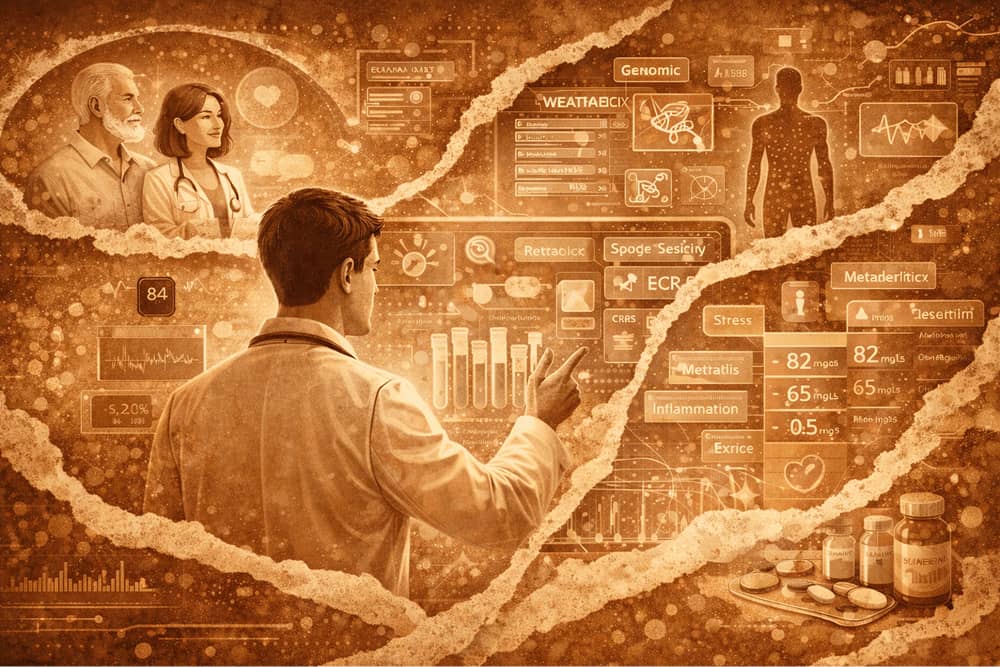
There is a version of preventive medicine that most physicians already carry in their heads as an ideal. A patient walks in, and the physician sees the full picture at once: years of lab trends, wearable data showing sleep architecture and HRV patterns, genomic risk markers, metabolic history, lifestyle inputs, and clinical notes from every provider involved in that patient’s care. From that complete view, the physician moves directly into the work that medicine is actually about: thinking, reasoning, and building a personalized plan designed to keep this specific person healthy for decades.
That version of preventive medicine is no longer theoretical. It is the standard we should hold the field to, and the one we built Longevitix to deliver.
The global precision medicine market reached $151.57 billion in 2024 and is projected to grow to $469 billion by 2034, according to Lifebit (2025). The momentum behind that number is not driven by new molecules or novel diagnostics alone. It is driven by the growing recognition that the value in all that clinical data compounds when it is seen together, interpreted in context, and acted on by a physician with the full picture in front of them.
The Clinical Decision Changes When the Picture Is Complete
A physician looking at a standard metabolic panel sees a snapshot. A physician looking at the same panel alongside a patient’s wearable-derived sleep trends, inflammatory markers, body composition trajectory, and family history sees a story. Those two experiences lead to different conversations, different interventions, and different patient outcomes.
Research published in the Journal of Medical Internet Research (2025) on multimodal data integration in healthcare confirms what clinicians intuitively know: combining genomics, imaging, EHR data, wearables, and patient-reported outcomes into a unified view produces more accurate diagnoses, more personalized treatment plans, and measurably better patient outcomes compared to any single data source in isolation. A review of 50 peer-reviewed papers published between 2020 and 2024 found that integrating structured and unstructured patient data consistently improves performance across diagnosis, prognosis prediction, and personalized treatment planning.
The practical implication is significant. Predictive analytics applied in primary care settings have led to up to a 48% improvement in early disease identification rates for conditions such as diabetes and cardiovascular disease, according to research cited by Omdena’s Predictive Healthcare 2026 analysis. That kind of early identification is the foundation of genuine longevity medicine, and it becomes possible when data streams are unified rather than siloed.
What a Unified Patient Picture Actually Looks Like
From Fragments to a Coherent Clinical Narrative
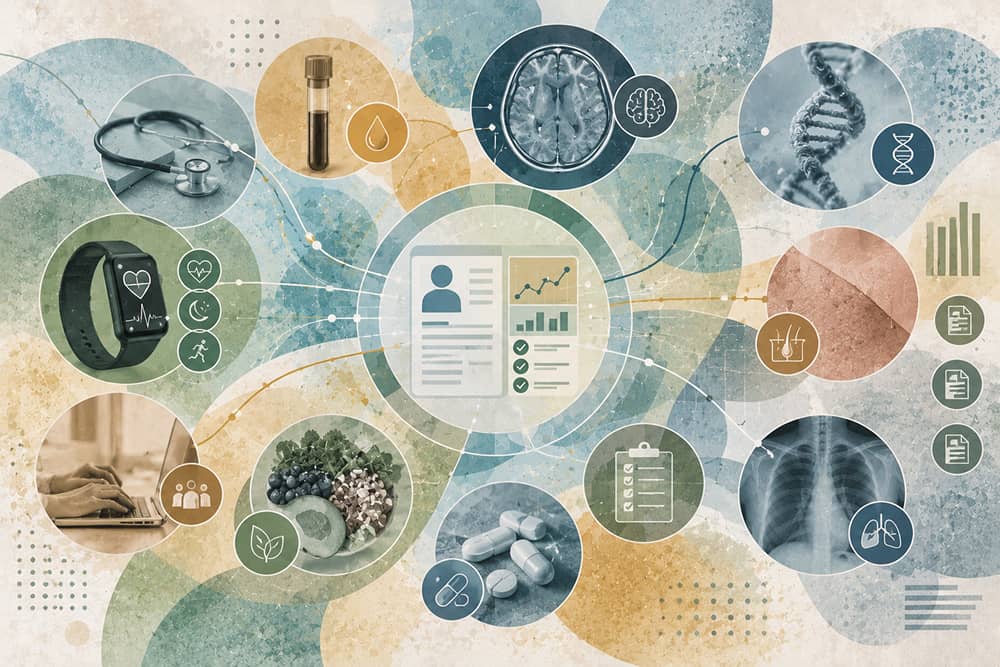
Most physicians practicing preventive or longevity medicine today work across at least eight separate data sources: EHR systems, specialty labs, genetic testing platforms, wearable device apps, imaging providers, intake questionnaires, patient-reported outcomes, and, increasingly, microbiome and metabolomics reports. Each of those sources tells part of a story. None of them, on their own, tells the whole one.
A unified patient picture brings all of those streams into a single clinical intelligence hub. Lab results sit alongside wearable trends. Genomic risk markers appear in the context of current biomarkers. Longitudinal data across years of care becomes visible as a trajectory rather than a series of disconnected events. The physician stops moving between platforms and starts thinking about the patient.
Dr. Eric Topol, founder and director of the Scripps Research Translational Institute, has described this shift directly: “The future of medicine is about getting the right data to the right doctor at the right time, so that each patient gets the care that is right for them.” The infrastructure to do that now exists. The question is whether clinics are built to use it.
Patterns That Only Emerge Across Modalities
One of the most meaningful capabilities that unified data unlocks is the ability to identify patterns that no single data source would reveal. A patient whose fasting insulin is trending upward, whose HRV data shows declining recovery over six months, and whose sleep architecture has shifted toward lighter stages may be showing early signs of metabolic dysfunction years before any standard lab value crosses a clinical threshold.
Each of those signals, viewed individually, falls within a normal range. Viewed together across a timeline, they tell a physician that intervention is warranted now, not at the next annual checkup. This is what longitudinal, multimodal clinical intelligence makes possible, and it is the practical definition of proactive care.
The Physician’s Role Evolves Into Clinical Strategist
More Time for the Work That Matters
When data synthesis is handled by purpose-built clinical AI, the physician’s time reallocates toward the work that cannot be automated: clinical reasoning, patient communication, judgment calls at the edge of evidence, and the relational work that makes patients follow through on their care plans.
This reallocation has direct clinical consequences. Physicians who spend less time assembling data spend more time interpreting it, and the quality of the resulting interventions reflects that. Personalized longitudinal intervention plans, designed to systematically reduce chronic disease risk over 10 to 20-year horizons, require the kind of physician engagement that becomes possible when the infrastructure handles the complexity.
AI as a Clinical Co-Pilot, Not a Replacement
The distinction worth making clearly is that unified data platforms and clinical AI are not replacing physician judgment. They are expanding its scope. Every recommendation surfaced by a system like Longevitix’s Clinical Clarity Engine is traceable to published research, fully editable by the physician, and subject to the Multi-Layer Clinical Safeguard system that keeps all outputs within validated clinical boundaries.
The physician remains the decision-maker. The platform ensures they are making decisions with complete information rather than partial information, and that the evidence behind each intervention pathway is visible and accessible at the point of care. That combination of clinical authority and AI-powered synthesis is what elevates a practice from reactive care management to genuine precision preventive medicine.
Longitudinal Care: The Real Unit of Longevity Medicine
Chronic Disease Prevention Operates Over Decades
The biology of chronic disease does not operate on a visit-by-visit timeline. Cardiovascular risk, metabolic dysfunction, cognitive decline, and inflammatory aging accumulate over years and decades. A care model designed to address those trajectories needs to operate on the same timescale, tracking changes, measuring intervention response, and adjusting protocols based on how an individual patient’s biology responds over time.
Longitudinal intervention planning, built on a continuously updated unified patient record, makes that model practical. Physicians can set 10-year risk reduction targets, monitor progress against those targets across every visit, and adjust the protocol when new data warrants it. The patient’s care becomes a managed trajectory rather than a series of episodic encounters.
Continuous Engagement Between Visits
Longitudinal care also requires continuity between clinic visits, not just within them. Automated engagement tools that send reminders, collect progress data, and flag deviations from expected health trajectories keep patients active participants in their own care plans without adding administrative work to the clinical team.
A 2025 review published in BMC Public Health on clinical decision support systems confirms that continuous feedback loops between patients and their care teams improve adherence and clinical outcomes. When a patient knows their physician will see their wearable data and receive an alert if something changes, their engagement with the protocol strengthens. The care relationship becomes ongoing rather than transactional.
Building the Practice That Longevity Medicine Deserves
The vision of medicine as predictive, preventive, proactive, and personalized has been articulated for years. A February 2025 review in the Journal of Medical Internet Research describes this shift as a “left shift” in medicine, where the focus moves from treating disease after onset to systematically preventing it through digital health integration, personalized analytics, and continuous monitoring. The science to support it exists. The clinical knowledge is widespread among the physicians already practicing in this space. What has been missing is the operational infrastructure to deliver it consistently, at scale, across a patient panel of any size.
Unified patient data, purpose-built clinical AI, organ-system-level analysis across 15 clinical domains, and continuous patient engagement tools together form that infrastructure. They do not change what good preventive medicine looks like. They make it possible to deliver it reliably, for every patient, in every appointment, without the manual overhead that has historically limited the reach of this kind of care.
This is the practice that longevity medicine has always been building toward. The tools to run it are here.
FAQ
Q: What is unified patient data in the context of longevity medicine?
Unified patient data refers to the integration of all relevant health information for a single patient, including EHR records, specialty lab results, wearable device outputs, genetic testing, imaging, microbiome data, and patient-reported outcomes, into one coherent clinical view. Rather than a physician accessing each of these sources separately, a unified platform aggregates and synthesizes them so that patterns, trends, and risk signals that span multiple data types become visible in a single interface.
Q: How does multimodal data integration improve clinical decision-making?
Clinical decisions made from a single data source carry inherent blind spots. A biomarker panel tells you the current state of specific metabolic markers. Wearable data tells you about recovery, sleep, and autonomic function. Genomic data tells you about inherited risk. Each source adds a dimension of context. When those dimensions are synthesized into a unified picture, physicians can identify compound risk patterns that no individual test would surface, leading to earlier, more targeted interventions and more personalized care plans.
Q: What does longitudinal patient care mean in practice for a longevity clinic?
Longitudinal care means that a patient’s health is managed as a continuous trajectory across years, not as a series of isolated appointments. In practice, this involves tracking biomarker trends over time, measuring how a patient’s biology responds to specific interventions, adjusting protocols based on that response data, and maintaining engagement between visits through automated check-ins and progress tracking. The goal is a care model that operates on the same timescale as chronic disease prevention, which is measured in years and decades rather than visit cycles.
Q: How does Longevitix handle data from multiple labs and wearable platforms?
Longevitix connects to major EHR systems via HL7/FHIR and integrates data from specialty labs, wearable devices, imaging providers, genomic testing platforms, and clinical notes into a single unified patient summary. The platform is HIPAA compliant, SOC 2 certified, and ISO 27001 certified. A Business Associate Agreement is included as standard. Physicians access all patient data through one interface without switching between systems or assembling reports manually.
Q: Which physician specialties benefit most from unified clinical data platforms?
Physicians practicing in preventive medicine, functional medicine, integrative medicine, concierge medicine, lifestyle medicine, and longevity medicine see the most immediate impact because their practice model requires synthesizing data from more sources than traditional specialty care. That said, the model extends naturally to preventive cardiology, brain health and cognitive longevity programs, women’s health, hormonal health, and any specialty adding a structured preventive care layer to their practice.