Back
Back
Predictive Medicine vs. Diagnostic Medicine: what’s what and where does it matter most?

Dr. Neil Panchal
Chief Medical Officer
Share:

Diagnostic medicine answers the question: “What do you have?”
Predictive medicine answers a different one: “What are you heading toward?”
Predictive medicine is a clinical approach that uses longitudinal data, including lab trends, wearable signals, genetic risk scores, and AI-driven pattern recognition, to estimate the probability of future disease and intervene before symptoms appear. Unlike diagnostic medicine, which identifies conditions already present, predictive medicine focuses on trajectory over time to reduce preventable morbidity.
That distinction sounds simple. In practice, it changes how a physician thinks, what data they need, and when they intervene.
Most of modern medicine is built around diagnosis. A patient presents with symptoms. You run tests. You identify the condition. You treat it. This works well for acute problems. But for chronic disease, metabolic dysfunction, cardiovascular risk, and neurodegeneration, the diagnostic model has a fundamental limitation: by the time you can diagnose it, the damage is already underway.
An estimated 795,000 Americans die or are permanently disabled annually due to diagnostic errors. Not because clinicians are careless, but because the system relies on catching disease at a single moment in time. At least 1 in 20 US adults experiences a diagnostic error each year, with error rates estimated at 10-15% across most clinical areas.
Predictive medicine flips the sequence. Instead of waiting for disease to declare itself, you track the trajectory of risk over time and intervene at the earliest signal of deviation.
This is not theoretical. Preventive and longevity medicine clinics are building it right now.
Diagnostic Medicine: the Snapshot Model
Diagnostic medicine is built on a simple framework: test, identify, treat.
A patient gets an annual physical. You order a lipid panel. LDL comes back at 132 mg/dL. The reference range says that’s borderline. You note it, maybe mention lifestyle changes, and schedule a follow-up next year.
That single data point is a snapshot. It tells you where a patient is right now. It tells you almost nothing about where they are going.
Diagnostic snapshots miss three things:
- Direction. Is that LDL climbing from 98 over three years, or dropping from 160 after a statin?
- Context. What does that LDL look like alongside Lp(a), ApoB, hsCRP, and the patient’s family history?
- Subclinical signals. The patient feels fine. Their labs are “in range.” But their metabolic trajectory is deteriorating in ways a single panel cannot reveal.
The limitation is in the model, not in the physicians using it. Annual snapshots were designed for a world where we could not collect data between visits. That world no longer exists.
Research on the effectiveness of annual checkups reinforces this limitation. Studies have found that 40-60% of diagnostic tests ordered during routine checkups may be unnecessary, while simultaneously missing the longitudinal trends that actually predict disease progression.
Predictive Medicine: the Trajectory Model
Predictive medicine does not replace diagnostics. It adds a temporal dimension that diagnostics alone cannot provide.
Instead of asking “Is this value normal?”, predictive medicine asks:
- Is this value trending in a concerning direction over the last 6, 12, or 24 months?
- Does this trend correlate with changes in other biomarkers, wearable data, or lifestyle factors?
- Does this patient’s genetic risk profile make this trend more clinically significant than it would be for someone else?
The tools that make this possible are maturing fast.
Polygenic Risk Scores (PRS)
PRS quantify genetic predisposition across hundreds or thousands of variants. In cardiovascular disease, AI-optimized PRS models now identify high-risk patients who benefit from early lipid-lowering therapy, years before a cardiac event would trigger diagnostic workup. A 2025 systematic review found that AI-enhanced PRS models significantly outperform traditional scoring by integrating clinical risk factors, imaging data, and multiple genetic scores into a single predictive framework.
Applications in breast cancer screening, type 2 diabetes prediction, and Alzheimer’s risk stratification are following closely. For Alzheimer’s specifically, machine learning approaches using PRS achieved C-index values of 0.80 to 0.84 for predicting amyloid PET burden, a key early biomarker.
Longitudinal Biomarker Tracking
Static lab values become dynamic trend lines. A fasting glucose of 99 mg/dL is “normal.” That same value, viewed as the latest point in a two-year upward trend alongside rising HOMA-IR and increasing glycemic volatility on CGM data, is a patient heading toward metabolic dysfunction.
As I wrote in Beyond Biomarkers: The Evolution from Diagnostic to Predictive Medicine, the shift is from “out of range” to “out of pattern.” The individual trajectory matters more than the population reference range.
Wearable-Derived Signals
Continuous physiological data fills the gap between clinic visits. Research shows that wearable data can detect early disease signals at “tipping points” where deviations begin to exceed background noise but the disease process is not yet established.
The clinical evidence is growing quickly:
- Smartwatches have demonstrated the ability to detect arrhythmias, inflammatory states, and infection patterns before patients report symptoms.
- Wearable-derived motor activity features can forecast clinical Alzheimer’s onset, with longitudinal studies showing disrupted sleep and activity patterns predicting dementia 8-15 years before diagnosis.
- A 2025 deep learning model using continuous wearable vital signs predicted clinical deterioration up to 17 hours in advance.
As I explored in Your Apple Watch Data Needs a Doctor, wearable data without clinical governance is consumer wellness. With physician oversight, it becomes a clinical signal.
Epigenetic Clocks
These measure biological aging rate, not just chronological age. As I wrote in The Race to Measure Aging Just Changed Everything, tools like DunedinPACE give clinicians a way to quantify whether interventions are actually slowing the aging process at a molecular level, not just improving a single lab value.
Predictive vs Diagnostic Medicine: a Direct Comparison
| Diagnostic Medicine | Predictive Medicine | |
|---|---|---|
| Core question | “What does the patient have?” | “What is the patient heading toward?” |
| Temporal focus | Present (single snapshot) | Longitudinal (trajectory over months/years) |
| Data sources | Labs, imaging, physical exam at one point in time | EHR trends + labs + wearables + genomics, continuously |
| Trigger for action | Symptoms or abnormal result | Trend deviation from personal baseline |
| Reference standard | Population-based ranges (“normal” LDL < 100) | Individual baselines and trajectory slopes |
| AI role | Pattern matching within a single encounter | Cross-modal trend detection over time |
| Intervention timing | After disease is identifiable | Before disease meets diagnostic criteria |
| Primary limitation | Misses subclinical progression | Probabilistic, not deterministic |
A Clinical Example: Same Patient, Two Models
Consider a 44-year-old male executive. No symptoms. Feels great. Exercises three times a week.
Diagnostic model: Annual physical. Basic metabolic panel. Lipids. CBC. Everything is “within normal limits.” The physician says: “Looks good. See you next year.”
Predictive model: Same patient, but now you have 18 months of longitudinal data:
- Fasting glucose has climbed from 88 to 97 mg/dL across three panels. Still “normal.” The slope matters.
- CGM data shows post-meal glucose spikes exceeding 160 mg/dL three to four times per week, with increasing glycemic variability.
- HRV from his wearable has dropped 18% over six months. Sleep efficiency is declining.
- His polygenic risk score puts him in the 82nd percentile for type 2 diabetes.
No single data point is alarming. The trajectory is.
In the diagnostic model, this patient gets reassurance. In the predictive model, he gets a targeted intervention (dietary modification, glucose optimization, possibly metformin or a GLP-1 discussion) years before he would ever meet the criteria for a diabetes diagnosis.
The difference is timing, not better tests.
Why Predictive Medicine Needs Different Infrastructure
You cannot practice predictive medicine with diagnostic-era tools.
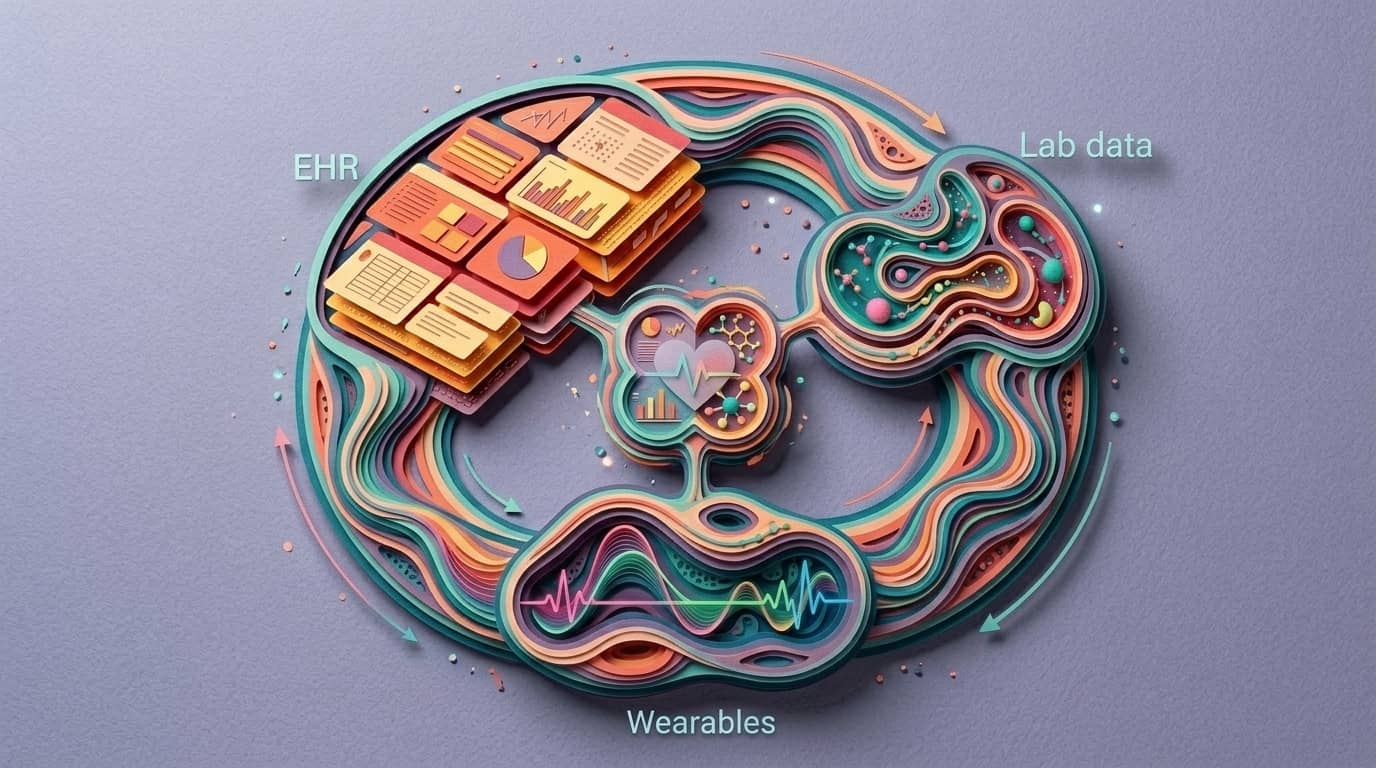
Unified data across sources. Predictive models need EHR data, lab trends, wearable signals, and genomic profiles in one place. Most clinics still have these in separate portals that don’t communicate. You cannot track a trajectory if the data lives in five different tabs.
Longitudinal tracking, not episodic snapshots. Diagnostic medicine documents encounters. Predictive medicine tracks change over time. That requires systems designed for time-series data, rolling baselines, and trend visualization. Most EHRs were not built for this.
Clinically governed AI. Pattern recognition across multimodal data streams is where AI adds genuine value. The AI has to operate within physician-defined parameters, not as a black box. AI’s greatest value in this space is what it surfaces for human review, not what it decides on its own.
Personalized reference ranges. Population-based thresholds (“normal” LDL is under 100) are useful starting points. Predictive medicine requires individual baselines. A patient whose HRV has been consistently at 45ms does not need the same alert threshold as someone whose baseline is 72ms.
This is the infrastructure gap we are building Longevitix to close: unified patient data, clinically governed AI, and protocol automation built for the trajectory model.
The Limits of Predictive Medicine (and Why They Matter)
Predictive medicine expands what diagnostics can do. It does not replace them, and it comes with its own limitations responsible clinicians have to acknowledge:
- Probabilistic, not deterministic. A high polygenic risk score means elevated probability, not certainty. Communicating risk without creating unnecessary anxiety is a clinical skill predictive medicine demands.
- Data quality matters. Wearable data is noisy. Lab values have inherent variability. Predictive models are only as good as the data feeding them.
- Not every trend requires intervention. The goal is reducing preventable morbidity, not treating every fluctuation. Clinical judgment remains essential.
- Equity and access gaps. Polygenic risk scores have been predominantly developed using European-ancestry cohorts. Expanding these tools to diverse populations remains an active research priority and an ethical imperative.
- Regulatory maturity is uneven. CMS and payer frameworks are built around diagnostic codes. Reimbursement for trajectory-based interventions in asymptomatic patients remains a work in progress, though value-based care models are accelerating the shift.
Predictive medicine at its best is a physician armed with better data, better tools, and better timing. It still requires the same clinical reasoning that good medicine has always demanded.
Diagnostic Catches Disease. Predictive Catches Trajectory.
Diagnostic medicine catches disease after it arrives. Predictive medicine identifies the trajectory that leads there and creates a window to change course. The clinics that adopt trajectory-based thinking now will catch problems their diagnostic-only peers will not see for years.
Frequently Asked Questions
What is predictive medicine?
Predictive medicine uses longitudinal data (lab trends, wearable signals, genetic risk scores, clinical history) to estimate the probability of future disease and guide early intervention. It focuses on trajectory over time rather than a single diagnostic snapshot, aiming to prevent disease before it meets standard diagnostic criteria.
How is predictive medicine different from diagnostic medicine?
Diagnostic medicine identifies conditions already present using tests at a single point in time. Predictive medicine tracks data trends across months or years to estimate where a patient is heading. The core difference is temporal: diagnostic is present-focused, predictive is forward-looking.
How is predictive medicine different from preventive medicine?
Preventive medicine is the broader discipline focused on preventing disease (screenings, vaccines, lifestyle counseling). Predictive medicine is a specific approach within it that uses data modeling, AI, and longitudinal tracking to quantify individual disease risk before symptoms appear.
What tools does predictive medicine use?
The core tools include polygenic risk scores, longitudinal biomarker tracking, wearable-derived physiological data (HRV, sleep architecture, continuous glucose), epigenetic clocks like DunedinPACE, and AI-driven pattern recognition across these data streams.
Does predictive medicine replace the annual physical?
No. Annual exams remain valuable for clinical evaluation and patient relationship. Predictive medicine supplements them with continuous data collection and trend analysis between visits, catching changes that an annual snapshot would miss.
Is predictive medicine only for high-risk patients?
No. Its greatest value may be in “healthy” patients who appear fine on standard diagnostics but whose longitudinal data reveals early subclinical trends. These are the patients who benefit most from early, targeted intervention.
What role does AI play in predictive medicine?
AI excels at identifying patterns across large, multimodal datasets that humans cannot process manually. In predictive medicine, AI flags meaningful trend deviations, correlates data across sources, and prioritizes which patients need attention. It has to operate under physician governance, not autonomously.
How accurate are polygenic risk scores in 2026?
Accuracy varies by condition and population. For cardiovascular disease, AI-optimized PRS models have shown significant improvement over traditional scoring. For Alzheimer’s, ML-based PRS achieved C-index values of 0.80 to 0.84. Most PRS were developed using European-ancestry cohorts, and expanding validation to diverse populations is an active priority.