Back
BackThe Race to Measure Aging Just Changed Everything. Here’s What Inspired Us to Build…
Dr. Neil Panchal
Co-founder and Chief Medical Officer
Share:
I’ve been following Eric Verdin’s work for years now, and when I saw him share the TIME article on biological age testing, something clicked into place for me. Not because the article revealed anything groundbreaking about the science (Eric and the team at the Buck Institute have been pushing these boundaries for over a decade) but because it crystallized exactly why we built Longevitix the way we did.
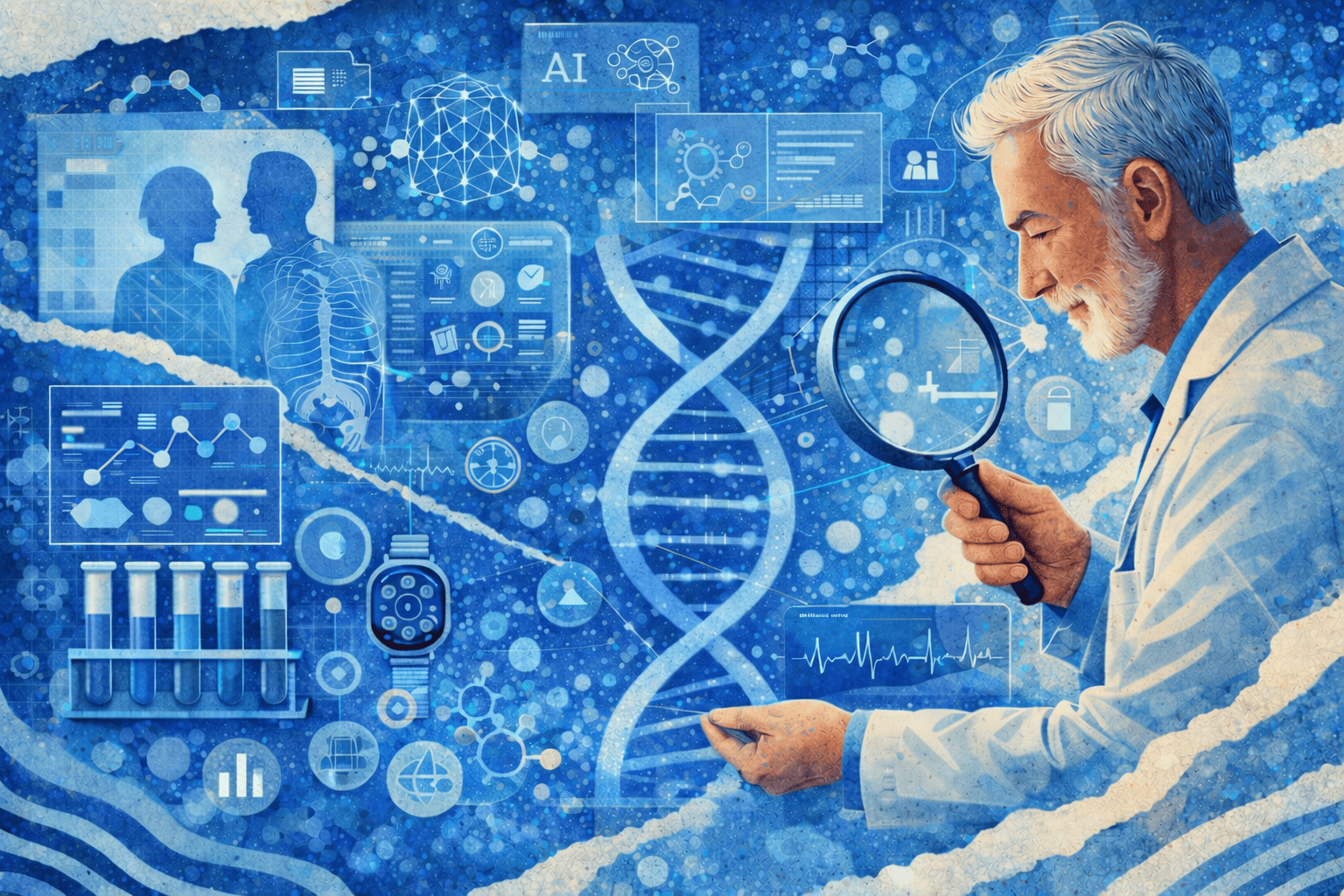
Eric writes about how the Buck Institute, in collaboration with Phenome Health, is recruiting people for a clinical trial to identify biomarkers that can reliably predict biological age and diseases of aging. They’re using AI to analyze over 100,000 different variables: proteins, metabolites, epigenetic marks, lipids, wearable device data. The goal is to understand which markers are relevant, stable, and most predictive for disease and lifespan.
This is exactly the kind of rigorous, evidence-based approach that inspires me about the work happening at the Buck. But here’s what keeps me up at night: we’re getting really good at measuring aging. The question is, what do we do with that information once we have it?
The Measurement Revolution Is Here
The TIME article paints a picture of a field in rapid evolution. People are flocking to longevity clinics to find out their biological age. Tech entrepreneurs like Bryan Johnson claim they’re aging only six months for every chronological year. Scientists like Eric use biological age clocks together with wearables and blood tests to track their health.
As Eric notes in the article, he’s years younger biologically than chronologically, which encourages him to continue his healthy habits: Mediterranean diet, prioritizing sleep, and regular exercise. This is a perfect example of how measurement can motivate and validate lifestyle choices.
But the article also highlights a critical gap. As Martin Borch Jensen from Norn Group points out, existing clocks are largely “consumer longevitainment.” The problem isn’t that they’re inaccurate. It’s that “nobody quite knows how these clocks actually work or if they work at all” in terms of driving clinical decisions.
Tony Wyss-Coray at Stanford, whose work on organ-specific aging using protein biomarkers is groundbreaking, emphasizes the need for interpretable measurements with clear causal links. He uses the lipid panel as an example: doctors understand cholesterol’s role in cardiovascular health, making it an accurate and meaningful predictor.
That’s the standard we need to reach with biological age clocks. Not just correlation with outcomes, but understanding of mechanisms that enables clinical action.
What Eric and the Buck Institute Are Teaching Us
I have tremendous respect for what Eric Verdin has accomplished. His background in HIV research, his pioneering work on sirtuins and histone deacetylases, his transition to aging research: it’s a masterclass in following scientific questions wherever they lead and building expertise that augments over time.
What strikes me most about the Buck Institute’s approach is the comprehensiveness. They’re not just measuring one type of biomarker. They’re looking at the whole picture: epigenetic marks, metabolites, proteins, lipids, functional assessments, wearable data. They’re using AI not to replace human understanding but to find patterns in datasets too complex for traditional analysis.
This is backed by the U.S. government’s Advanced Research Projects Agency for Health (ARPA-H), which launched a longevity initiative in December aimed at finding gold-standard biological age clocks for use in clinical trials testing anti-aging interventions.
We’re moving from “can we measure biological age?” to “which measurements matter most, and how do we use them?”
Eric’s personal approach is equally instructive. He doesn’t rely on a single test. He combines clocks with wearables and regular blood work to get a comprehensive view. He tracks trends over time. And critically, he uses the data to inform decisions about diet, sleep, and exercise: interventions with strong evidence behind them.
The Gap Between Measurement and Outcomes
Here’s where my emergency medicine background kicks in. In the ER, we measure constantly. Heart rate, blood pressure, oxygen saturation, lab values. But measurement alone doesn’t save lives. What saves lives is the clinical infrastructure that turns measurements into interventions, monitors response, adjusts treatment, and coordinates care across multiple touchpoints.
The same principle applies to longevity medicine, but the infrastructure doesn’t exist yet.
Let’s say a patient comes to a preventive care clinic and their biological age is five years older than their chronological age. What happens next?
n an ideal world:
- The clinic identifies which organ systems or metabolic pathways are driving the accelerated aging
- They order appropriate specialty labs to understand the underlying mechanisms
- They design evidence-based interventions tailored to the patient’s specific issues
- They establish monitoring protocols to track whether interventions are working
- They adjust the protocol based on retesting and patient feedback
- They maintain accountability and coaching to ensure adherence over months or years
In reality, most clinics can’t do this systematically. Not because they don’t want to, but because the operational infrastructure doesn’t exist. They’re using EMRs built for acute care, spreadsheets to track specialty labs, manual processes to coordinate retesting, and heroic individual effort to maintain patient engagement.
Biological age clocks are giving us better measurements. But we need clinical systems that can act on those measurements at scale.
Why We Built Longevitix
This is the gap we saw, and it’s why we built Longevitix.
We started with a simple observation: preventive and longevity medicine clinics were drowning in complexity. They wanted to offer comprehensive care (genetics, epigenetics, microbiome, hormones, metabolic panels, cognitive assessments, wearable data) but they had no unified system to coordinate it all.
Every clinic was building their own protocols in spreadsheets. Testing schedules were tracked manually. There was no systematic way to identify which patients needed follow-up. Retesting intervals were inconsistent. Data from different sources never came together in one place.
Most critically, there was no feedback loop. Clinics couldn’t easily see whether their interventions were actually moving biological age markers in the right direction across their patient population.
So we built infrastructure that handles the entire patient journey:
- Initial Assessment: Coordinating baseline testing across multiple specialty labs, integrating results into unified patient profiles
- Protocol Design: Evidence-based intervention pathways that clinicians can configure to match their practice philosophy
- Monitoring & Retesting: Automated schedules that ensure patients get retested at appropriate intervals, with alerts when results need clinical review
- Intervention Tracking: Documentation of supplements, medications, lifestyle changes, and patient compliance
- Outcome Measurement: Longitudinal views showing whether biological age markers, metabolic health, and functional capacity are improving
- Patient Engagement: Tools that keep patients accountable between appointments and engaged in their health journey
This isn’t revolutionary technology. It’s operational infrastructure that lets clinics do what researchers like Eric Verdin have been doing for years: measure comprehensively, track longitudinally, adjust interventions based on data, and maintain the discipline to follow patients over time.
Where the Field Is Headed
The TIME article mentions that several longevity experts, including Douglas Vaughan at Northwestern’s Potocsnak Longevity Institute, are building human longevity laboratories where people can get comprehensive biological age assessments. They’re measuring body composition with DEXA scans, cardiac and vascular aging, gait speed, grip strength, pulmonary function, retinal imaging, and molecular clocks.
This is exactly the right approach, but these comprehensive assessments are expensive and time-intensive. They work at academic medical centers with research funding. The challenge is bringing this level of rigor to private practice clinics that need to see patients at scale while maintaining quality.
That’s where purpose-built clinical infrastructure becomes essential. We need systems that can:
- Democratize access: Make comprehensive longevity assessments feasible for clinics that aren’t academic medical centers
- Standardize quality: Ensure that evidence-based protocols are followed consistently across different providers
- Enable research: Aggregate de-identified data so we can learn what interventions actually work in real-world settings
- Scale personalization: Help clinicians deliver individualized care without requiring heroic manual effort
Eric mentions in the article that the Buck Institute is trying to identify which biomarkers are “relevant and stable” and “most predictive for disease and lifespan.” This research is critical. But just as important is building systems that can operationalize those insights once we have them.
The Human Element Still Matters Most
One thing that comes through clearly in Eric’s work and personal health approach is that measurement informs behavior, but it doesn’t replace it. He uses biological age clocks, but he also follows fundamental lifestyle practices: Mediterranean diet, sleep prioritization, regular exercise.
The article quotes him saying his biological age being younger than his chronological age “encourages him to continue his healthy habits.” That’s the key word: encourages. The data provides feedback and motivation, but the sustained behavior change comes from human discipline and accountability.
This is why we’ve been adamant that Longevitix supports clinician-patient relationships rather than replacing them. AI can identify patterns in 100,000 variables. Technology can coordinate specialty testing and track interventions. But patients still need human coaches who understand their specific challenges, adjust recommendations based on lived experience, and provide accountability over months and years.
The most advanced biological age clock in the world won’t change patient behavior without this human element. That’s not a limitation of the technology. That’s recognition of what drives sustained health outcomes.
What Comes Next for Longevitix
Reading the TIME article and Eric’s commentary reinforced something we’ve believed from the beginning: the field is moving toward multi-modal, comprehensive assessment. Single biomarker clocks are giving way to integrated views that combine epigenetics, proteomics, metabolomics, functional testing, and continuous monitoring data.
This creates both opportunity and challenge for clinics. Opportunity because comprehensive assessment enables more precise, personalized interventions. Challenge because coordinating all of this data without proper infrastructure is overwhelming.
We’re focused on building systems that scale with the field’s sophistication:
- Integration with emerging biomarker platforms as they become clinically validated
- Longitudinal tracking that shows trends across multiple dimensions of biological age
- Decision support that helps clinicians interpret complex results and design evidence-based interventions
- Outcome measurement that validates whether protocols are actually improving health span
But we’re also staying grounded in what clinics need today: reliable systems for coordinating care, tracking patients, ensuring follow-through, and maintaining quality across their practice.