Back
BackChoosing a Wearable to Recommend: What the Validation Data Supports

Gaby Hayon
Co-Founder and CTO
Share:
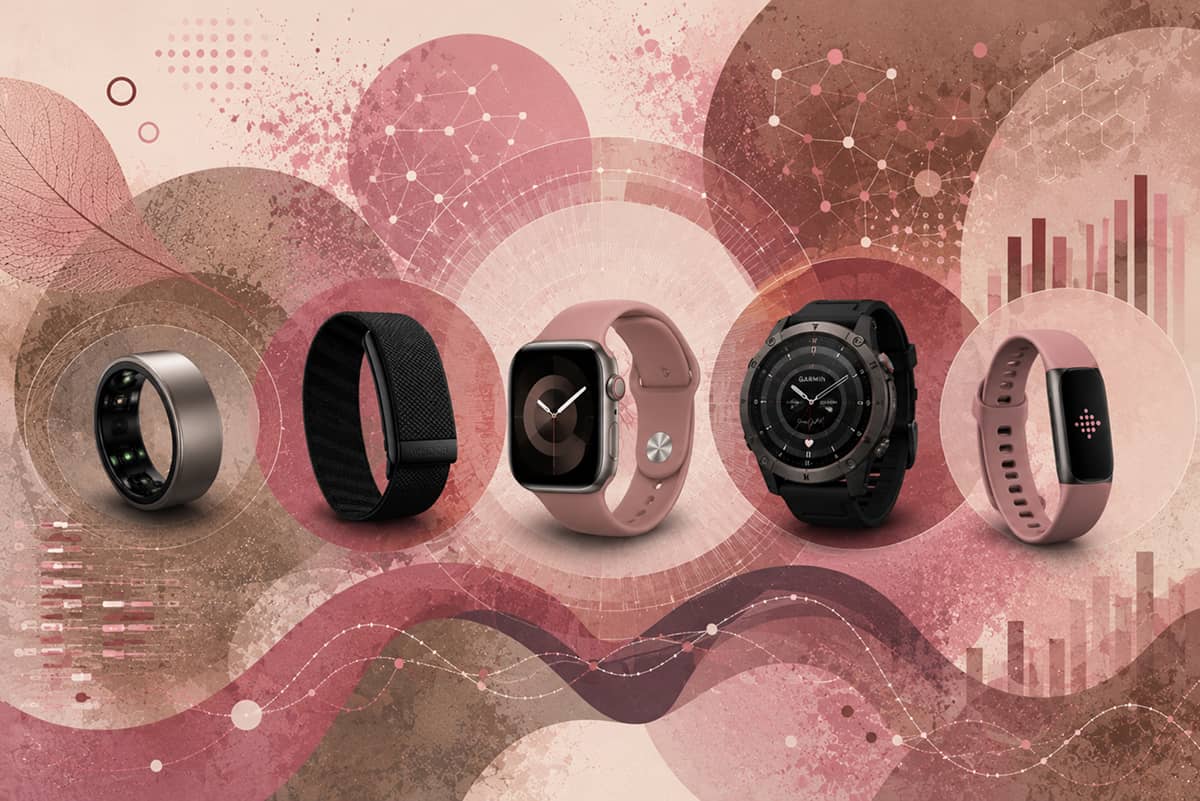
Physicians get asked this constantly, usually at the end of an appointment and usually in the form “which one should I get”. The honest answer takes longer than the moment allows, so it tends to come out as a brand name, a shrug, or a version of “they’re all about the same”.
The validation literature has improved enough over the past year to support something better than a shrug.
Where the numbers come from
The most useful recent dataset compares five consumer devices against electrocardiogram during sleep. Thirteen healthy adults wore the devices simultaneously across 536 nights, which is a small cohort and a large number of nights, and the results were published in Physiological Reports.
For heart rate variability, Oura Gen 4 reached a concordance correlation coefficient of 0.99 and Gen 3 reached 0.97, against WHOOP 4.0 at 0.94. For resting heart rate the pattern held, with Oura Gen 4 at 0.98, Gen 3 at 0.97, and WHOOP 4.0 at 0.91.
The structural explanation is anatomical rather than algorithmic. Arteries in the finger sit closer to the surface than at the wrist, which produces a cleaner blood volume pulse signal and less motion artefact during sleep. A ring has a physical advantage at these measurements that a wrist device cannot engineer away.
A note on who funded what
This matters enough to state plainly. The study above was independent. Several of the most widely circulated claims about wearable accuracy come from studies funded by the device manufacturer, including a frequently cited sleep study funded by Oura, and independent work has at times produced different rankings than vendor-funded work.
We mention this not to impugn any particular result. Vendor-funded research is a normal part of how devices get validated, and some of it is very good. Reading it alongside independent work, with the funding source visible, is simply how the literature should be read, and it is a habit worth carrying into the conversation with patients who arrive quoting a manufacturer’s marketing page.
What each device is built around
Accuracy at one measurement is not the same as suitability. The companies have made different bets about what they are for, and those bets show up in what the device measures well and what it presents to the user.
| Device | What the company optimises for | Practical strengths | Reasonable to suggest when |
|---|---|---|---|
| Oura | Sleep and overnight physiology | Strongest validated agreement for nocturnal HRV and resting heart rate; long battery life; unobtrusive | Sleep and recovery are the clinical question; the patient will not tolerate a watch overnight |
| WHOOP | Training load and recovery | Recovery framing that athletes engage with; strain modelling; no screen to distract | The patient is training seriously and wants load management |
| Apple Watch | Breadth of health features within a general-purpose device | Irregular rhythm notifications, ECG feature, fall detection, wide app ecosystem | The patient wants one device; cardiac rhythm features are relevant |
| Garmin | Endurance sport and outdoor use | Excellent GPS, multi-day battery, detailed training metrics | The patient is an endurance athlete or spends long periods away from charging |
| Fitbit | Accessible general activity tracking | Low cost of entry, straightforward interface | Cost is the constraint, or the patient wants something simple |
Where devices disagree, and why it matters less than it appears
Step counts differ between devices. So do calorie estimates, sleep staging, and to a lesser extent HRV. The reasons are mundane: different sensor sites, different sampling rates, different proprietary algorithms making different assumptions about what constitutes a step or a sleep stage.
The temptation is to treat disagreement as a reason to distrust the whole category. A more useful reading is that these devices are better at detecting change within themselves than at reporting absolute values that transfer between instruments. A resting heart rate of 58 on one device and 54 on another is not a contradiction to resolve. A resting heart rate that has risen from 54 to 61 over six weeks on the same device is a finding.
The same principle governs biological age clocks, where different methods routinely produce different numbers for the same sample, and it governs bathroom scales, which is why people are told to weigh themselves on the same one. Consistency of instrument is what makes a trend interpretable.
The part that actually changes clinical value
A device that measures beautifully and reports into an application the clinician never sees has limited clinical utility. The value appears when the data joins everything else: laboratory results, symptoms, medications, and the previous two years of the same measurements.
That is the problem we spend most of our engineering effort on at Longevitix. The platform is device-agnostic by design, currently reading from Apple Health, WHOOP, Garmin, Oura and Fitbit, with continuous glucose monitoring in development. The point of that breadth is not the list. It is that a clinician should not have to care which device a patient chose in order to see a trend, and a patient should not have to abandon a device they like in order to be properly monitored.
What a physician sees is a trajectory placed alongside the rest of the record, with the underlying source of every figure visible if they want to interrogate it. Whether the number came from a ring or a watch is, at that point, a detail.
The answer to give in the room
For a patient asking which device to buy, the shortest defensible answer runs roughly like this. The one they will actually wear every night is better than the technically superior one they abandon in a drawer. For sleep and overnight physiology the ring form factor has a measurable advantage. For training load a strap or a sports watch will serve them better. Whichever they choose, staying with it is what makes the data worth anything.