Back
Back
I trained in emergency medicine. The ED is where I first learned that the most important clinical skill is knowing what we do not know, fast, and acting under uncertainty without freezing.
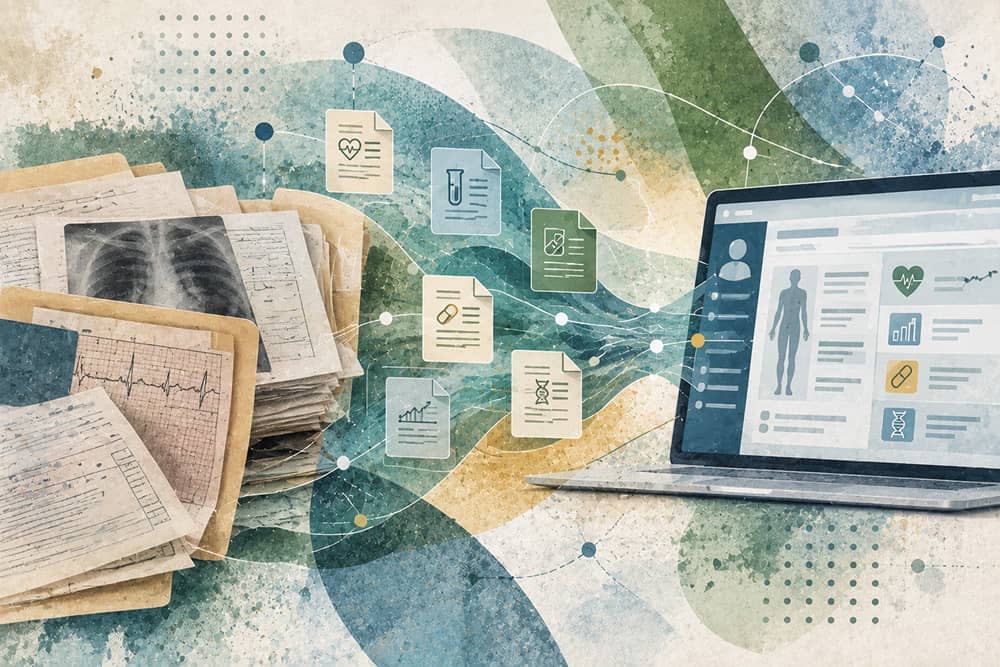
That instinct is exactly what physicians will need as agentic AI enters the physician AI workflow at scale. When I say agentic AI, I mean systems that do not just answer questions but initiate actions: drafting notes, flagging deteriorating patients, queuing orders, synthesizing longitudinal data before a clinician walks into the room. These are not future features. They are in production now, in clinics and hospitals across the country, and most physicians are navigating them without a clear frame for what the working relationship should actually look like.
I have spent the last several years working with these systems clinically, first as a user, then as a physician building physician-led, multi-agent clinical software for preventive medicine. What follows is what I actually expect the working day to look like three years from now, mapped across three dimensions: the relationship, the oversight, and the workflow.
This applies whether you work in emergency medicine, primary care, cardiology, a longevity practice, or any other corner of the house of medicine.
The Relationship: Attending and Resident
The single most useful frame I have found for working with agentic AI in healthcare is the one every physician already knows: the attending-and-resident relationship.
Think of it as a capable, motivated, sometimes overconfident trainee that produces work product faster than any human, often knows the recent literature better than we do on a given Tuesday, and will occasionally tell us with full confidence that the patient in front of us needs a treatment that would harm them. That is the attending-and-resident dynamic. We have worked with it for over a century, and most of us have been that trainee ourselves.
The structure is well understood. The trainee proposes, the attending decides, and the attending owns the outcome. The trainee does not get autonomy until competence is repeatedly demonstrated, and even then, the high-stakes decisions stay with the supervising physician.
This frame solves more than it gets credit for.
It tells us when to trust: lower-stakes, high-frequency tasks where the system has shown consistent performance over time. It tells us when to push back: when the flagged output diverges from our clinical judgment or does not account for what we know about this specific patient. And it tells us where accountability sits: with us, every time, regardless of what the system surfaced.
It also calibrates expectations correctly. Residents grow. So will these systems. The relationship will evolve as competence accumulates, exactly as it does in training. The attending who refuses to delegate anything to a capable resident is creating a bottleneck. The attending who delegates everything without supervision is creating a liability. The right answer sits between those two failure modes, and medicine already knows how to find it.
The physicians who are struggling most with agentic AI right now are treating it as either a threat or a magic tool. Neither frame survives contact with actual clinical use. The attending-and-resident model does.
Oversight: Interrogation, Not Signature
Here is where our community needs to be honest with itself. The failure mode in three years will not be AI taking over. It will be physicians stopping to read.
I have seen this pattern up close. In building Longevitix, one of the earliest and most consistent problems we encountered was not that clinicians rejected AI-generated outputs. It was that they accepted them too quickly. A pre-visit brief generated at 7am, reviewed for four seconds before the patient walked in. A draft note approved without checking the assessment. A risk flag acknowledged and left unactioned because there was no workflow attached to it.
Passive deferral is the real risk, and it is already here.
Research supports this at scale. Studies show that physicians override between 90% and 96% of EHR-generated clinical alerts, and one analysis found that only 7.3% of medication-related alerts were clinically appropriate. When the signal-to-noise ratio is that poor, clinicians stop reading on autopilot. That habit does not disappear just because the underlying AI gets more sophisticated. A more confident and fluent AI makes passive deferral more dangerous.
Meaningful oversight looks like the way we already evaluate a consult note. We read it. We ask: does this clinical reasoning track? Does the flagged output match the patient in front of us, or a generalized version of them? What did this system not see? What is the differential we would consider that the algorithm did not surface?
This takes the same epistemic discipline we apply to any source of clinical information. A lab result, a radiology read, a colleague’s verbal handoff. None of those are accepted uncritically. Neither should an AI output.
Some physicians are deeply skeptical of these tools right now, and I take that skepticism seriously. Much of it is well-earned. The skeptics are right to push back. We need that skepticism focused closely enough to catch what the systems miss. That means understanding, at least functionally, how these systems are built and how they fail.
We also need to be in the rooms where these tools are being designed and governed. The EHR era is the most recent and most painful example of what happens when physicians are not at the table. The agentic era is being designed right now. Those decisions are not going to wait.
Practically, when you override an AI output, document the reasoning. Write a clinical sentence: “Given [patient-specific factor], elected to defer the flagged escalation pending [specific finding].” That documentation pattern holds up to the patient, to the institution, and to a court.
The Workflow: What the Day Actually Looks Like
Concretely, three years from now, the encounter structure will look like this for most of us.
Pre-Encounter
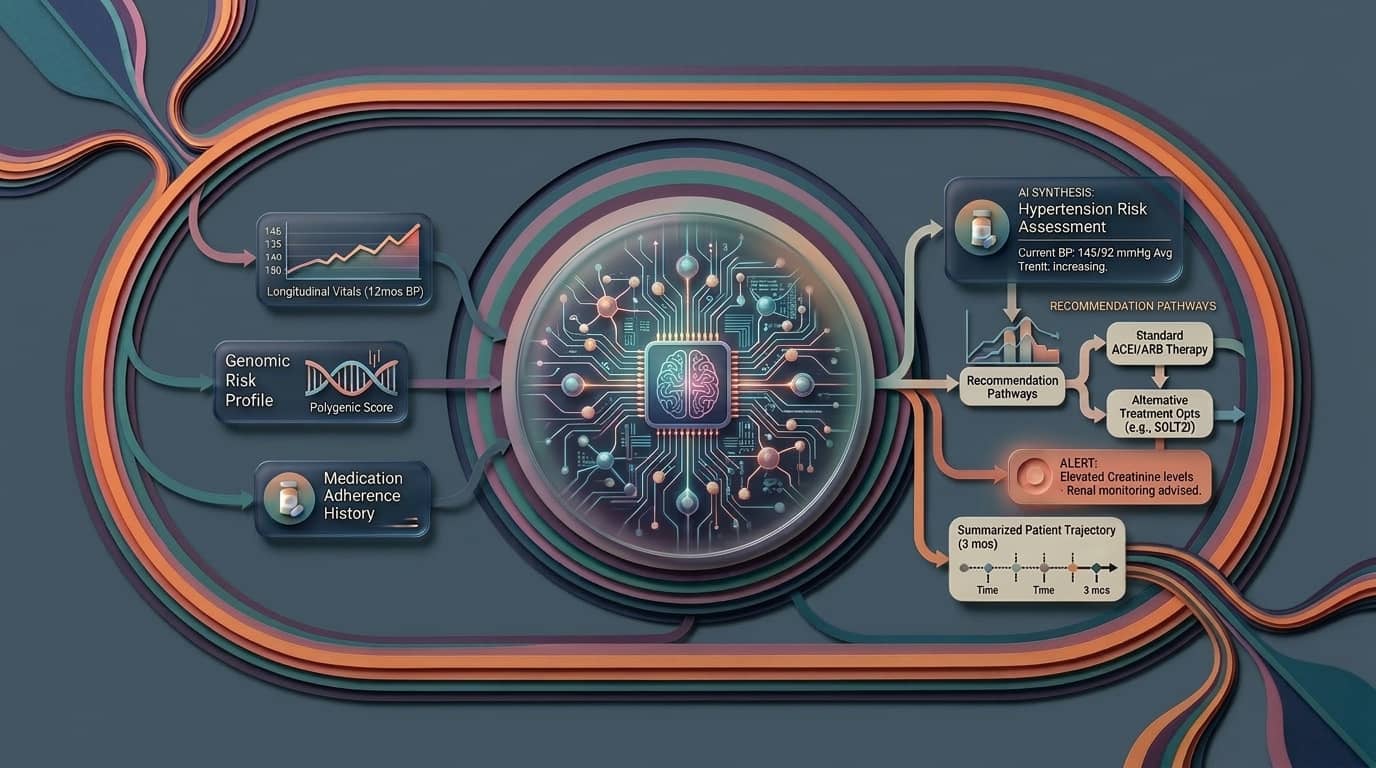
An AI brief lands before the patient walks in. In an ED, that might be triage-flagged trends across boarded patients and a synthesized handoff from the prior shift. In primary care, it is the longitudinal trajectory: labs, vitals, adherence signals, anything new since the last visit.
In the longevity and preventive practice where I now spend most of my time, this is where the pre-encounter brief becomes genuinely powerful. A complete picture of lipid trajectories including ApoB and Lp(a), wearable-derived autonomic signals, biological age markers, and queued possible interventions with the supporting reasoning attached. A structured synthesis of what has changed since the last visit and what warrants attention today.
The brief is the resident’s pre-rounds presentation. The attending reads it, applies judgment, and walks into the room already oriented. That orientation compounds over time. A physician who has seen a patient’s longitudinal trajectory across 18 months of continuous data makes different decisions than one reconstructing context from a 10-minute chart review.
This is one of the most underappreciated shifts in preventive medicine right now: AI making it possible for physicians to actually use the data that already exists, while the decisions remain where they belong.
Intra-Encounter
Clinical decision support triggers fire when relevant: a flagged interaction, a guideline mismatch, a missed screening, an out-of-range trend. The good systems are quiet by default and surface the right signal at the right moment. The bad ones fire constantly and train physicians to ignore them.
Our job intra-encounter is to acknowledge, accept, or override, and stay present with the patient. The AI sits behind the encounter. It should never come between the physician and the patient. That distinction matters clinically and relationally. Patients notice when their physician is navigating a screen instead of listening to them. The tools that support presence are worth adopting. The ones that fragment it are not.
Post-Encounter
The ambient scribe captures the visit. A draft assessment and plan is generated, often with proposed orders and patient instructions attached. We read it the way we would read a resident’s note: closely, with intent, and with a willingness to edit.
Documentation time drops measurably with ambient AI. Reading time should stay the same. The note is complete when the physician signs it, having actually read it. The AI produces a draft; the physician owns what gets signed. That review catches the misattributed finding, the flipped qualifier, the fluent sentence with a wrong fact in it.
The post-encounter workflow is also where the data compounds. A well-structured note from today becomes training data for the pre-encounter brief three months from now. The longitudinal value of good documentation is real, and AI makes the cost of generating it lower. That is a genuine win, but only if the quality of what gets signed holds.
The Honest Picture
None of this requires physicians to become system architects or prompt engineers. It requires the same posture we already bring to clinical work: structured supervision, honest skepticism, and clear ownership of the decision.
The physicians who will navigate this well are the ones who treated the AI with the same rigor they bring to any other clinical tool. They asked what the evidence shows. They calibrated their trust to demonstrated performance. They documented their reasoning when they disagreed. And they stayed in rooms where the design decisions were being made.
Medicine has used that frame for over a hundred years. It still works.
Frequently Asked Questions
What is agentic AI and how is it different from standard AI tools in clinical settings?
Standard AI tools respond to specific inputs: a lab value, an image, a query. Agentic AI initiates actions autonomously within a defined scope: generating a pre-encounter brief, flagging a deteriorating patient, drafting a note, queuing a follow-up. The distinction matters clinically because agentic systems require a different oversight model. They are taking actions, and those actions need physician review.
How should physicians document when they disagree with an AI output?
Write a clinical sentence, not a binary override. “Given [specific patient factor], elected to defer the flagged escalation pending [specific clinical finding]” is defensible documentation. “Overrode AI” is not. The reasoning is what protects the patient, the physician, and the institution.
What does meaningful AI oversight actually look like in practice?
It looks like the way you read a consult note. Does the reasoning track? Does the flagged output fit this patient specifically, or a generalized version of them? What did the system not have access to? What would you have added to the differential? That interrogation takes 60 to 90 seconds per output and is the difference between oversight and rubber-stamping.
Which clinical workflows benefit most from agentic AI right now?
Pre-encounter synthesis, ambient documentation, and population-level risk stratification have the strongest evidence base and the clearest fit with existing workflows. Intra-encounter decision support is valuable when calibrated tightly but creates alert fatigue when it is not. The ROI scales with how well the tool integrates into the workflow rather than interrupting it.
How does the attending-and-resident frame help with AI adoption?
It gives physicians a mental model they already trust. It sets appropriate expectations: the AI proposes, the physician decides, and the physician owns the outcome. It calibrates trust to demonstrated performance rather than to vendor claims. And it provides a path for the relationship to evolve as the systems improve, which mirrors how clinical training actually works.
Is there a liability risk to using AI-generated clinical documentation?
Yes, if the physician signs without reading. The legal standard is the same as it has always been: the physician is responsible for the content of the note they sign. AI-generated documentation does not change that standard. It changes the speed at which the draft is produced. The review obligation stays with the physician.