Back
Integrated Women’s Health: One Hormonal Event, Many Clinics

Dr. Neil Panchal
Co-founder and Chief Medical Officer
Share:

Picture a 51-year-old woman with hot flashes, broken sleep, new joint pain and palpitations. In one year she may see her primary care physician, a gynecologist, a cardiologist, a sleep specialist, an orthopedist and a therapist. Each one treats the organ system in front of them, and treats it well.
None of their charts is organized around the event connecting her symptoms: the decline of ovarian estradiol across the menopause transition.
Integrated women’s health means reading those symptoms on one timeline. This article covers why that matters, what the evidence shows about estrogen withdrawal across organ systems, and what a shared clinical layer needs to include.
A third of life after menopause
The average age at the final menstrual period in the US is about 51. With life expectancy above 80, most women live 30 years or more after menopause.
That is a third of adult life spent in a different hormonal state, with care still organized as if menopause were a gynecology event.
Why integrated women’s health starts with estrogen withdrawal
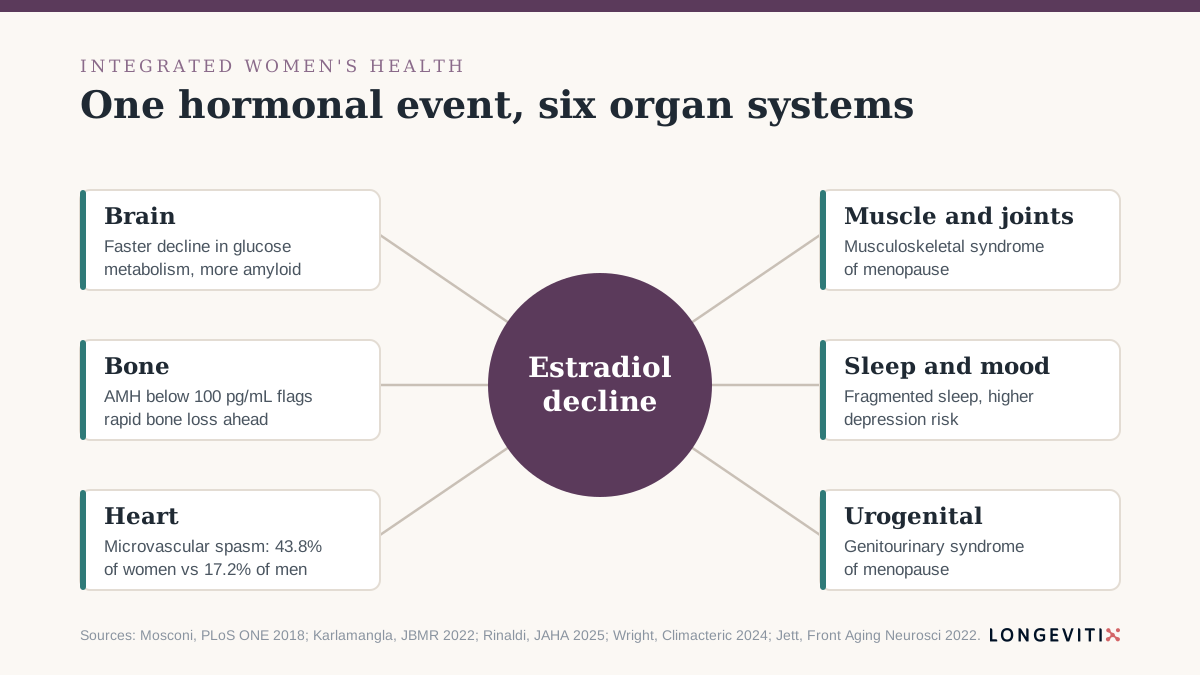
Estrogen receptors sit in bone, blood vessels, brain, muscle, skin and the urogenital tract. When estradiol falls, each of those tissues responds.
Brain: In a three-year imaging study, perimenopausal and postmenopausal women showed faster decline in brain glucose metabolism, more amyloid deposition and more gray matter loss than premenopausal women and age-matched men (Mosconi et al., PLoS ONE 2018). A 2025 study found perimenopause is a distinct window of white matter reorganization (Raikes et al., Scientific Reports 2025).
Bone: In the SWAN cohort, an anti-Müllerian hormone level below 100 pg/mL identified women about to enter rapid bone loss, and its accuracy rose as women moved through the transition (Karlamangla et al., JBMR 2022). AMH is usually read as a fertility marker. Here it works as an early bone signal.
Heart: Among 519 patients who underwent acetylcholine provocation testing, microvascular spasm appeared in 43.8% of women and 17.2% of men (Rinaldi et al., JAHA 2025). Ischemia with non-obstructive coronary arteries is more common in women and is still under-diagnosed (Ford et al., Heart, Lung and Circulation 2025).
Muscle and joints: Orthopedic surgeon Vonda Wright and colleagues described the “musculoskeletal syndrome of menopause” in 2024, grouping joint pain, sarcopenia, tendon injury and frozen shoulder under one hormonal driver.
Sleep and mood: Vasomotor symptoms fragment sleep, and the transition carries a higher risk of depression (Jett et al., Frontiers in Aging Neuroscience 2022).
Each of these findings lives in a different specialty’s journals. The patient experiences them as one body.
STRAW+10 gives everyone the same timeline
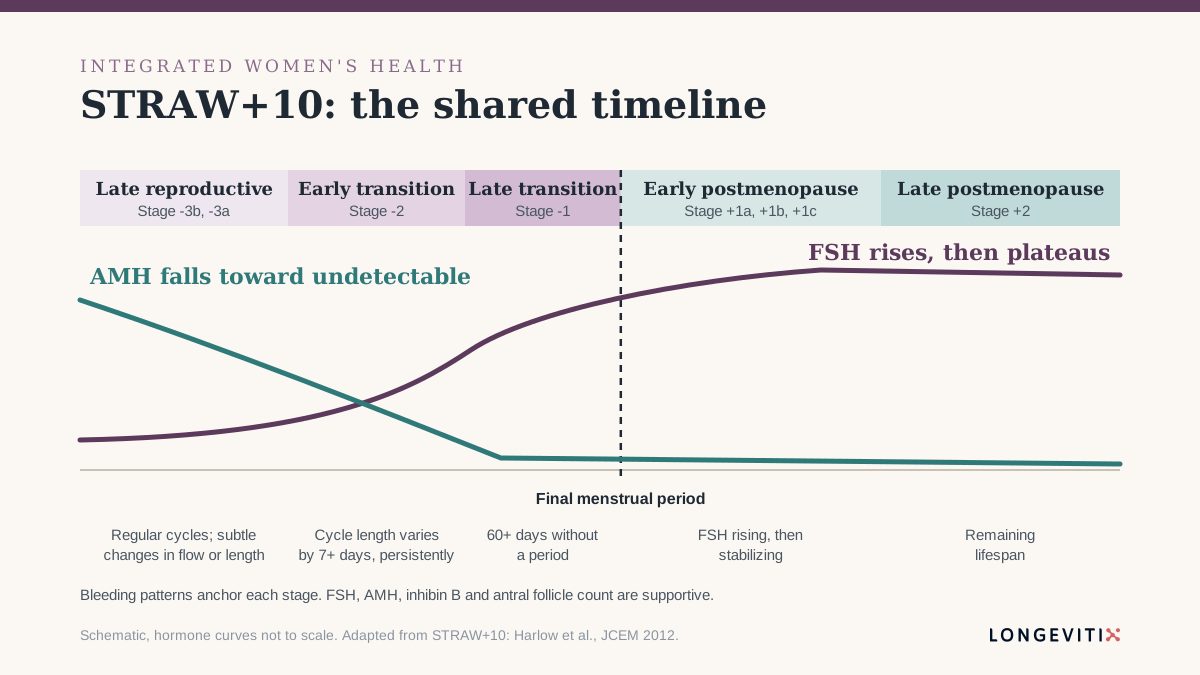
The Stages of Reproductive Aging Workshop +10 framework stages women from the late reproductive years through late postmenopause (Harlow et al., JCEM 2012). Bleeding patterns anchor the stages. FSH, AMH, inhibin B and antral follicle count support them.
Stage changes how you read everything else. An FSH value, a new arrhythmia or a drop in bone density means something different in late reproductive years than in early postmenopause. When every clinician on a patient’s team works from the same stage, their findings start to line up.
What the market has built so far
Menopause care has attracted large investment in recent years, and it has produced real progress:
- Telehealth services that diagnose and treat menopause symptoms, often with hormone therapy
- Wearables and cycle apps that track temperature, heart rate and sleep across the cycle
- Longevity clinics that run broad biomarker panels
- Specialty EHRs built for OB/GYN documentation and billing
The wearable signal is clinically usable. An Oura ring study detected the biphasic temperature curve, heart rate shifts and lower luteal-phase HRV across the menstrual cycle in healthy women (Alzueta et al., International Journal of Women’s Health 2022). We reviewed which devices hold up in choosing a wearable to recommend.
Each of these tools solves part of the problem. The piece still missing sits underneath them: one longitudinal record where reproductive stage, symptoms, biomarkers, wearable data and medications are read together, by the physician, over time. Our guide to specialist coordination in longevity clinics covers the workflow side of that problem.
Symptoms belong in the record as data
Validated patient-reported outcome scales exist for menopause. The Menopause Rating Scale and the MENQOL questionnaire are the most used. Both were validated in the late 1990s and early 2000s, with little re-validation since, which is a gap worth naming.
They still beat a free-text note. Sent before the visit, scored, and returned into the next encounter, they turn “she feels worse” into a trend you can track against labs and sleep data.
How we built Longevitix around this problem
At Longevitix, we designed the platform so women’s health runs through every organ system in the record, with reproductive stage as context everywhere:
- Reproductive stage sits alongside every lab value, symptom score and medication.
- Sex-stratified pharmacokinetic data is flagged at prescribing (see [Post 1 link: women’s health and drug dosing]).
- Patient-reported outcome scores, labs and wearable trends appear on the same timeline.
- The platform surfaces patterns linking estrogen decline to bone, vascular, metabolic, sleep and brain changes, and shows the evidence behind each link.
- Suggested interventions draw from the women’s health literature and the clinic’s own protocols.
The platform surfaces the information and the evidence. The physician reviews it and decides.
Where the evidence is still thin
Some questions have no good answer yet. There are no women-specific randomized trials for senolytics, rapamycin or NAD+ precursors, even as women ask about them. Menopause symptom scales need updating for an era of continuous data.
A shared clinical record will make those gaps easier to see, and easier to study.
FAQs
What is integrated women’s health?
It is care organized around the menopause transition as a whole-body event, with one longitudinal record that every clinician involved can read, covering stage, symptoms, labs, imaging, wearables and medications.
What is STRAW+10?
It is the standard staging system for reproductive aging, published in 2012. It uses bleeding patterns as the main criteria and hormone markers as support.
Can AMH predict bone loss?
In the SWAN cohort, AMH below 100 pg/mL identified women about to enter rapid bone loss during the transition. It can help time a bone density scan.
Which wearable data is useful in perimenopause?
Skin temperature, resting heart rate, HRV and sleep fragmentation. Trends over weeks carry more information than single nights.